Editor’s Note:
This article was originally written by Mark W. Medley following the severe flooding that affected Jakarta in 2007. While some of the specific observations reflect conditions at that time, flooding remains a seasonal challenge in parts of Greater Jakarta today. Significant investments have been made in flood control infrastructure, river normalization projects, reservoirs, pumping stations, and drainage improvements, yet heavy rainfall, land subsidence, urban development, and tidal flooding continue to create flood risks in some areas.
We have retained Mark’s firsthand account as a snapshot of Jakarta during one of its most challenging flood events. Readers should note that emergency response capabilities, weather forecasting, flood monitoring systems, and transportation alternatives have improved considerably since 2007.
Article contributed by Mark W. Medley, author of City of Dreams: An Extraordinary Journey Inside the Heart of Indonesia’s Capital – Jakarta.
Beating the Jakarta Floods
Floods are inevitable in Jakarta, and no area seemed immune during the major flood events that affected the city. So how do you beat these floods?
Indonesians are very adaptable people and often find practical solutions rather than simply waiting to become trapped in a flooded area. Many take off their shoes, roll up their trousers or jeans, and wade through the water, carefully making their way through the least flooded sections of the street.
Drivers have a different solution. They park on the highest piece of available ground and wait. If the flooding worsens, they lock up their cars and join the slow-moving lines of people making their way through the water.
Some drivers take a chance and attempt to drive through flooded roads, risking an engine stall or worse. Owners of larger vehicles and SUVs often feel more confident attempting the crossing, although even they can find themselves stranded.
I developed my own flood survival kit after being caught in floods too many times. Armed with a patient smile and a small backpack containing an umbrella, a pair of rubber sandals, waterproof trousers, an extra T-shirt, a small towel, and several waterproof bags for my mobile phone, wallet, and valuables, I would simply make my way out on foot.
After being stranded twice in serious flooding—once for more than eleven hours—I learned not to wait indefinitely. If the rain continued for an hour and the water kept rising, I would join the slowly moving stream of people heading for safer ground and then figure out how to get home or back to the office.
One Friday, however, I discovered that even this strategy did not always work. Flooding can affect some areas while leaving others dry, cutting off major roads and creating temporary islands surrounded by water.
One way to judge the situation is by watching the traffic. No traffic in a city famous for traffic jams often means the road ahead is impassable. Traffic arriving from only one direction suggests that only one route remains open. If only large buses and trucks are getting through, smaller vehicles probably cannot pass.
Then comes another problem. If it is still raining and you find yourself stranded on a dry patch of road, there is no guarantee you will be able to find transport or even shelter. Restaurants, internet cafés, and hotels may be flooded themselves or preparing for rising water.
So what do you do when you are stranded on an island of dry land that used to be a major city highway?
Indonesians often have a practical answer. During severe floods, some people flag down large trucks and ask for a ride through flooded areas. These vehicles can often navigate roads that smaller vehicles cannot, bringing passengers closer to home before they continue on foot.

I even saw a backhoe loader carrying passengers one day. The driver had apparently come to rescue his family and then decided to help others along the way.
Floods are not amusing when they affect Jakarta’s business districts and major transportation routes. When key roads are cut off and access to the airport becomes difficult, normal city life slows dramatically. Yet ordinary Indonesians adapt quickly and find ways to keep moving, even when conditions are uncomfortable.
Jakarta is certainly not the only city in the world to face flooding. Cities in developed countries such as Australia and the United States have also experienced devastating flood events. However, Indonesia’s scale, population density, and infrastructure challenges make flood management particularly complex.
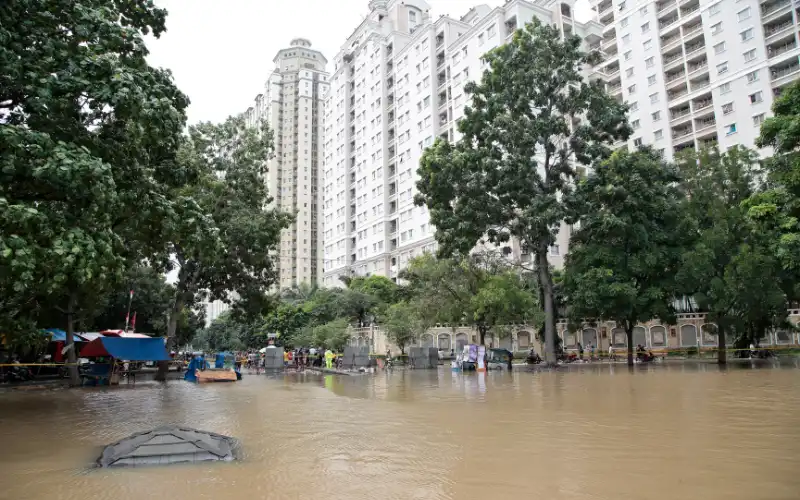
In 2007, Jakarta experienced one of its most severe flood disasters in modern history. For nearly two weeks, large parts of the city struggled under widespread flooding. Some neighborhoods were submerged under more than a meter of water, while others became effectively isolated for days.
Yet what many people remember is how calmly the city responded. Communities organized themselves, neighbors helped one another, and daily life resumed as quickly as circumstances allowed.
The question remains one that Jakarta residents continue to ask every rainy season:
Will the floods ever stop?
By Mark W. Medley
Jakarta Flooding Today
Flooding remains a concern in Jakarta, although the city has made significant progress since 2007.
Key factors contributing to flood risk today include:
- Heavy seasonal rainfall during the monsoon season.
- Overflow from Jakarta’s 13 rivers.
- Rapid urban development reducing natural water absorption areas.
- Land subsidence caused largely by excessive groundwater extraction.
- Coastal flooding (known locally as rob) in North Jakarta.
- Rising sea levels associated with climate change.
Experts continue to warn that land subsidence is one of Jakarta’s most serious long-term challenges. In some northern districts, the ground has sunk dramatically over recent decades, increasing vulnerability to both river and coastal flooding.
Flood Preparedness Tips for Residents
If you live in Jakarta during the rainy season:
- Monitor weather and flood alerts regularly.
- Keep important documents in waterproof containers.
- Maintain emergency supplies, including drinking water, flashlights, power banks, medications, and cash.
- Know alternative routes to home, work, and school.
- Avoid driving through floodwaters if water depth is unknown.
- Follow local government advisories and evacuation instructions.
- Consider flood risk when selecting housing, particularly in low-lying areas.
About the Author
Mark W. Medley is the author of City of Dreams: An Extraordinary Journey Inside the Heart of Indonesia’s Capital – Jakarta, a collection of observations and stories about life in Indonesia’s bustling capital city.