

Nyepi, the Hindu Day of Silence, celebrates the Hindu New Year on the Balinese Saka calendar. The largest celebrations are held in Bali as well as in Balinese Hindu communities around Indonesia. On New Year’s Eve the villages are cleaned, food is cooked for two days and in the evening as much noise is made as possible to scare away the evil spirits. On the following day, Hindus do not leave their homes, cook or engage in any activity. Streets are deserted, and tourists are not allowed to leave hotel complexes.
Commemorating the start of the Hindu New Year, Nyepi is calculated according to the Saka lunar calendar and falls at the time of the new moon in the months of March or April each year. The name Nyepi comes from the root word “sepi” meaning quiet or silent. Although it is a national holiday enjoyed by Indonesian residents throughout the country, Nyepi is celebrated in particular on the island of Bali where the majority of the approximately 4.4 million inhabitants practice the Hindu religion, as well as in Balinese Hindu communities around Indonesia.
For weeks before Nyepi you will see banners and billboards appearing across the island with celebratory phrases such as “Selamat Hari Raya Nyepi Tahun Baru Saka” (Happy Saka New Year). Each year the new Saka year number is prominently displayed — in 2026 Nyepi marked the arrival of Saka Year 1948, and in 2027 it will mark Saka Year 1949.
When is Nyepi? Nyepi falls on the new moon in March or April each year. Upcoming dates are:
- 2026: 19 March
- 2027: 8 April
- 2028: 27 March
Note: Dates are confirmed annually by the PHDI (Parisada Hindu Dharma Indonesia) and should be verified closer to the time, as the Saka lunar calendar does not map to fixed Gregorian dates.
While Galungan and Kuningan are considered amongst Balinese to be bigger and more important ceremonies, those days are not national holidays, like Nyepi.
Hinduism in Bali
Hinduism in Bali does resemble the religion as it is practiced in India, as the tenets of the Hindu faith were first brought to Bali from the 14th century Majapahit Kingdom of East Java. But they did not completely supplant the already existing strong religious beliefs and rich cultural life of the Balinese. Instead, Hinduism was blended with indigenous Bali Aga traditions and beliefs such as animism and ancestor worship to form a new and unique faith.
In Bali, religion is a very important part of everyday life and the people perform daily offerings to the gods and actively participate in the numerous temple festivals and rituals. Balinese Hindus also make offerings and perform temple rituals to placate demons that they believe personify the destructive forces of nature.
Nyepi Rituals Begin
On the day before Nyepi, major offerings are made to the demons at village crossroads, where evil spirits are believed to loiter. Before every ceremony a cleaning ceremony or mecaru must be held to drive out the devils and spiritually clean the place.
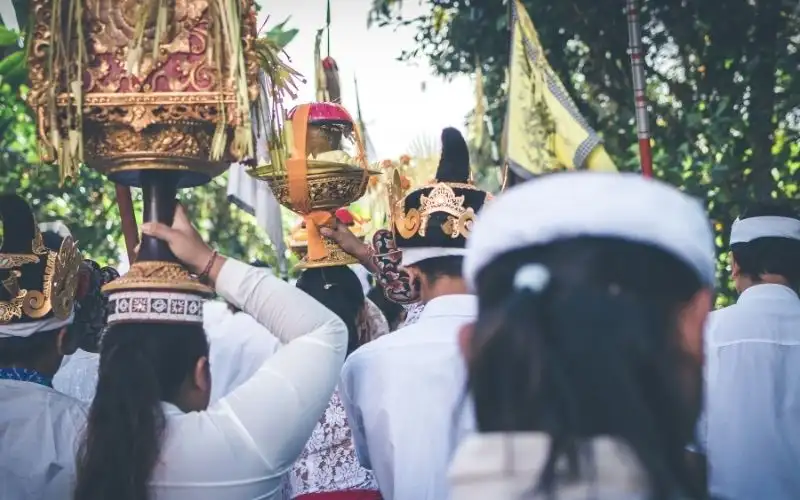
The rituals actually begin two days before Nyepi with the Melasti ceremony. On this day hundreds of people from each village carry temple artifacts to nearby beaches for purification. The people wear bright traditional clothing and join in colourful processions, starting early in the morning. The women carry tall offerings of fruit, cooked rice and natural foods on their heads, while some men walk along holding a long sheet of yellow and white cloth symbolising the Bridge of God. The elaborate ceremonies continue until early evening and are intended as spiritual purification for the whole village.
The day before Nyepi is known as Tawur Kesanga or Pengerupuk and is the day on which evil spirits are driven away. The villages and neighbourhoods are cleaned, enough food is cooked to last for two days and at dusk people start to bang pots and pans and carry torches through their houses. They join neighbours making fearful sounds and sprinkling rice over the alleyways and roads. Demon effigies and huge monsters with bulging eyes made of bamboo, papier-mâché and cloth — known as ogoh-ogoh — are carried through the streets in torch-lit parades. These demons represent the mythical giant Bhuta Kala and symbolise evil. This is traditionally the one day of the year when the ritual sacrifice of cockerels is permitted as part of the purification ceremony, as the spilling of blood holds spiritual significance in this context. It is worth noting that cockfighting as a gambling activity remains illegal in Indonesia, and the religious exemption applies specifically to the ceremonial sacrifice rather than to organised fighting for sport or wagering.
At the main crossroads, offerings are placed on the ground to entice the demons and evil spirits out of the homes in the village. The offerings — which are sometimes pungent and may include blood from small sacrificed chickens — are intended to lure out the devils and demons. The offerings for the gods are placed on platforms specially made for this purpose. Once the demons have been lured out, the priests recite curses on them in order to force them to leave the village. Everybody joins in to help by beating pots and tin cans, tooting vehicle horns and making as much noise as possible. This action is called mabuu-buu. Children go around the villages in groups, enjoying the fun.
The Day of Silence
On Nyepi, the Hindu Balinese refrain from all worldly and physical activities for 24 hours. It is customary to practice yoga semedi and catur berata penyepian, or the four abstinences. These are: amati geni (refraining from lighting fires and using lights), amati karya (refraining from working), amati lelanguan (refraining from indulging in leisure activities) and amati lelungan (refraining from travelling outside the house). All Hindu Balinese stay inside their homes, but they are not supposed to speak to each other, answer the telephone, receive guests, watch TV, listen to the radio or use any appliances. Lights must not be turned on and no fires may be lit, including stoves for cooking or even lighting a cigarette. They also refrain from eating and drinking and are not supposed to do any work or engage in any activity. The time should be spent in silent meditation or performing prayers at the house shrine or merajan. Nyepi is a day of self-control and introspection in order to achieve spiritual purification.
For expats and long-term residents living in Bali, Nyepi requires some practical preparation. Most supermarkets and convenience stores close from midnight on the eve of Nyepi and do not reopen until the following morning, so it is advisable to stock up on food, water, medications and anything else you may need at least a day in advance. Many expats who live in private villas or residential compounds observe a quiet day at home much as their Balinese neighbours do — keeping lights low in the evening, refraining from loud music or gatherings, and treating the day with the respect it deserves. This is genuinely appreciated by the local community.
How Nyepi Affects Tourists and Expat Residents
Visitors and expat residents are not allowed to leave their homes or hotels on Nyepi. The streets will be deserted with only a few pecalang — community security officers — ensuring that Nyepi is observed properly. Only emergency services and hospitals are allowed to operate as usual.

Mobile data and internet services are suspended across Bali for the duration of Nyepi, a blackout coordinated between the Bali provincial government, the PHDI and Indonesian telecommunications providers. The restriction applies primarily to mobile data networks. Some hotels and larger accommodation providers maintain limited fixed-line internet access for operational and emergency purposes, though many choose to observe the spirit of the blackout voluntarily. It is safest to assume you will be without internet for the full 24 hours and plan accordingly.
All airports and ports are also closed for 24 hours, with no flights arriving or departing on Nyepi. If you are planning to travel to or from Bali around Nyepi, always check your flight and ferry schedules carefully and allow a buffer of at least one full day either side of the holiday. These restrictions will affect travel plans, so be sure to check what day Nyepi falls on well in advance — see our [Indonesian holidays] page for the full calendar.
The Day After
The day after Nyepi is called Ngembak Geni. After successfully completing their day of restraint and purification, people feel very happy and enjoy going out to visit family and friends to ask forgiveness for past mistakes. In some communities, particularly among younger Balinese, Ngembak Geni has also become associated with playful water-throwing between friends and neighbours — a joyful release after the day of restraint that visitors often find unexpectedly charming.
Hindu Balinese, wherever they are living, always endeavour to celebrate Nyepi, but it is on the island of Bali itself that you can truly sense the special nature of this unique holiday.
Nyepi is determined using the Balinese Saka calendar, the eve of Nyepi falling on the night of the new moon whenever it occurs around March or April each year. Therefore, the date for Nyepi changes every year, and there is not a constant number of days between each Nyepi as there is for such Balinese holidays as Galungan and Kuningan. The day Nyepi falls on in a given year is determined by religious authorities based on the cycles of the moon for that year. Whenever the new moon falls between mid-March and mid-April, that night will be the night of the great activities and island-wide exorcism, while the next day will be the day of total peace and quiet, where everything stops for a full 24 hours.
Frequently Asked Questions About Nyepi
What is Nyepi?
Nyepi is the Balinese Hindu New Year, celebrated as a Day of Silence based on the Saka lunar calendar. It falls on the new moon in March or April each year. For 24 hours, the island of Bali observes a near-total halt to all activity — no travel, no work, no lights and no noise.
When is Nyepi in 2026 and 2027?
In 2026, Nyepi falls on 19 March. In 2027, it is expected to fall on 8 April, though this should be confirmed with the PHDI closer to the date.
Can tourists go out during Nyepi?
No. All residents and visitors — including tourists and expat residents — are required to remain in their accommodation for the full 24 hours of Nyepi. The streets are patrolled by community security officers known as pecalang, who ensure the rules are respected. Exceptions are made only for genuine medical emergencies.
Are shops and restaurants open on Nyepi?
No. Virtually all shops, restaurants, markets and businesses in Bali are closed on Nyepi. Visitors should stock up on food, water and any necessities at least a day before the holiday begins.
Is the internet available during Nyepi?
Mobile data and internet services are shut down across Bali for the duration of Nyepi. Some hotels may retain limited fixed-line connectivity for operational purposes, but visitors should plan to be offline for the full day.
Is Bali airport open on Nyepi?
No. Ngurah Rai International Airport in Bali is closed for the full 24 hours of Nyepi, with no flights arriving or departing. Seaports are also closed. Travellers should plan their itineraries accordingly and allow a full day’s buffer either side of Nyepi when booking flights.
What is an ogoh-ogoh?
An ogoh-ogoh is a large, elaborately crafted effigy — typically depicting a fearsome demon or giant — made from bamboo, papier-mâché and cloth. The ogoh-ogoh are paraded through the streets on the night before Nyepi (Tawur Kesanga) to drive evil spirits away from the village. The parades are spectacular and are one of the most popular events for visitors to witness during the Nyepi period.
What is the Melasti ceremony?
Melasti is a purification ceremony held two days before Nyepi, in which villagers carry sacred temple objects in colourful processions to the nearest beach or body of water. It is one of the most visually striking rituals of the Nyepi period and is generally open for respectful observation by visitors.