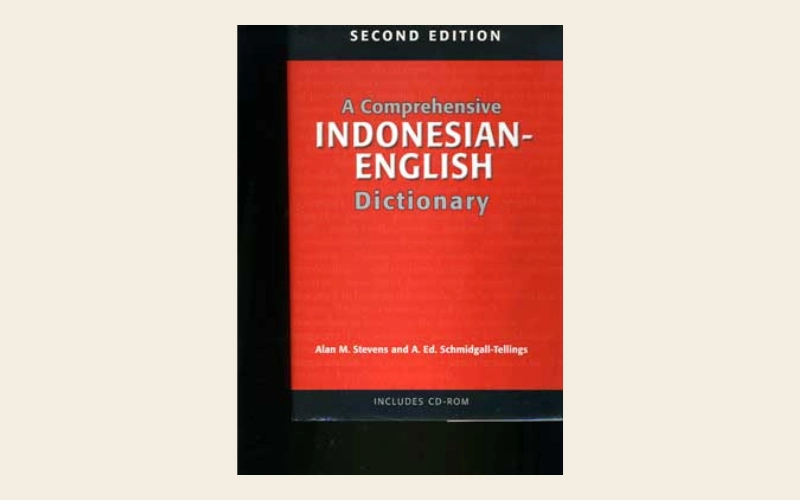


The official language of Indonesia is Bahasa Indonesia (literally, “the language of Indonesia”). It is the language that unifies the world’s fourth most populous country – a nation of more than 17,000 islands and hundreds of ethnic groups speaking more than 700 living languages and dialects. Bahasa Indonesia, a standardized form of Malay, is one of the most widely spoken languages in the world.
Malay-Indonesian is spoken by hundreds of millions of people throughout Southeast Asia. It is the dominant language of Indonesia and Malaysia and is also widely understood in Singapore and Brunei. Related forms of Malay are spoken in parts of southern Thailand, the Cocos (Keeling) Islands of Australia, and by communities of Malay descent around the world.
From the ninth to the fourteenth century, Malay was the court language of the great Sumatran maritime empire of Sriwijaya. It was also the language associated with the influential trading state of Malacca. As a result, Malay became the native tongue of people living on both sides of the Strait of Malacca that separates Sumatra from the Malay Peninsula.
In the centuries that followed, the Strait of Malacca became one of Asia’s busiest maritime trade routes. Merchants, travelers, and sailors from across the region came into contact with the Malay language and helped spread it throughout the Indonesian archipelago. Over time, Malay developed into a widely used lingua franca that allowed people from different ethnic and linguistic backgrounds to communicate with one another. Muslim and Christian missionaries also helped expand its use through religious education and publications.
By the time much of Indonesia came under Dutch colonial rule, Malay was already firmly established as a common language across the archipelago. The colonial administration adopted it as an important medium of communication between government officials and local populations alongside Dutch.
In the early twentieth century, as nationalist sentiment grew, Indonesia’s future leaders faced a significant challenge. The archipelago contained hundreds of ethnic groups and languages, making it difficult to identify a single unifying element. The solution was to adopt a standardized form of Malay as the language of national unity and rename it Bahasa Indonesia.
A defining moment came on October 28, 1928, when young nationalists gathered in Jakarta and proclaimed the Sumpah Pemuda (Youth Pledge). In this historic declaration, they pledged one homeland, one nation, and one language: Indonesia. The choice of Bahasa Indonesia helped create a shared national identity that transcended ethnic, regional, and cultural differences.
Bahasa Indonesia and Bahasa Malaysia: Similar but Not the Same
Although Bahasa Indonesia developed from the Malay language, modern Bahasa Indonesia and Bahasa Malaysia are no longer identical languages. They share a common linguistic foundation and remain mutually intelligible, but decades of separate development have created noticeable differences.
Following independence, Indonesia and Malaysia each standardized their own national language. While grammar remains very similar, vocabulary, pronunciation, spelling preferences, and everyday expressions have diverged over time.
One reason for these differences is the influence of other languages. Bahasa Indonesia absorbed many words from Dutch during the colonial period, while Bahasa Malaysia incorporated more vocabulary from English. For example, Indonesians commonly use kantor (office), derived from Dutch, while Malaysians are more likely to use pejabat. Indonesians say telepon genggam or HP for a mobile phone, while Malaysians commonly use telefon bimbit.

Many everyday words are different:
- Car: mobil (Indonesia) vs kereta (Malaysia)
- Vacation: liburan (Indonesia) vs cuti (Malaysia)
- Police: polisi (Indonesia) vs polis (Malaysia)
- Elevator: lift (Indonesia) vs lif (Malaysia)
Some words can even cause confusion because they carry different meanings in each country. A phrase that sounds perfectly normal in Indonesia may produce puzzled looks or laughter in Malaysia, and vice versa.
Pronunciation also differs. Indonesian is generally spoken with a flatter and more consistent pronunciation, while Malaysian Malay has developed its own distinct accent and regional variations.
Despite these differences, speakers from Indonesia and Malaysia can usually communicate with little difficulty, especially when speaking clearly and avoiding local slang. The relationship is often compared to that between British and American English: clearly related and mutually understandable, but with enough differences to remind speakers that they are using distinct national standards.
For expatriates learning Bahasa Indonesia, it is generally best to focus on Indonesian vocabulary and usage rather than relying on Malaysian learning materials. While many fundamentals are shared, learning the Indonesian forms will make communication easier in daily life, business, government interactions, and social settings throughout Indonesia.
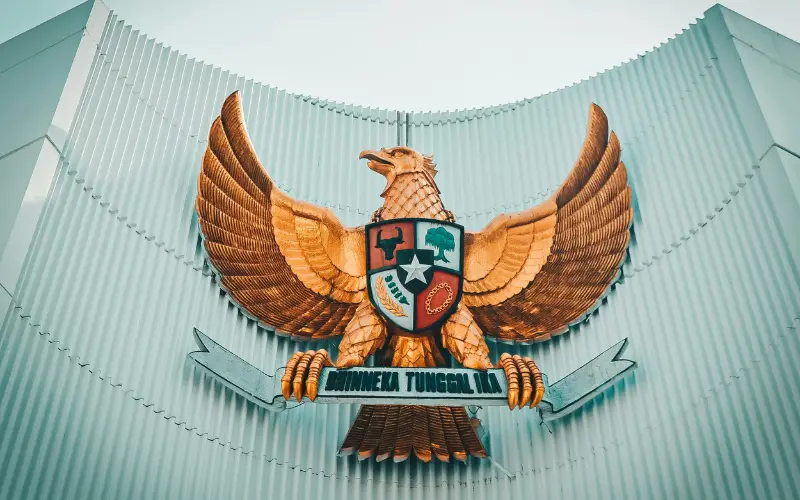
When Indonesia proclaimed its independence on August 17, 1945, the Proclamation of Independence, the Constitution, and the principles of Pancasila were all presented in Bahasa Indonesia. Following Indonesia’s successful struggle for independence, the language rapidly expanded in importance through education, government administration, media, and public life.
Today, Bahasa Indonesia is spoken by virtually all Indonesians and serves as the language of government, education, business, and national media. Most Indonesians are bilingual or multilingual, speaking Bahasa Indonesia alongside one or more regional languages such as Javanese, Sundanese, Balinese, Batak, Minangkabau, or Bugis. In many urban areas, children now grow up speaking Bahasa Indonesia from an early age while still maintaining connections to their local linguistic heritage.
One of the most remarkable achievements of modern Indonesia has been the successful adoption of a common national language while preserving the country’s extraordinary linguistic diversity. Bahasa Indonesia remains a powerful symbol of national unity and continues to evolve alongside Indonesia’s growing role in the global community.
Our thanks to Desmond Breau of Language Studies Indonesia for the original contribution that inspired this article.