

Editor’s Note:
From the hand-drawn batik of Solo’s royal workshops to the naturally dyed ikat of Sumba’s highland villages, Indonesia’s textile traditions are among the most varied and sophisticated in the world. This guide explains what you are looking at, what it means, and how to buy, wear and care for it well.
Originally contributed by Sue Potter
An archipelago of textile traditions
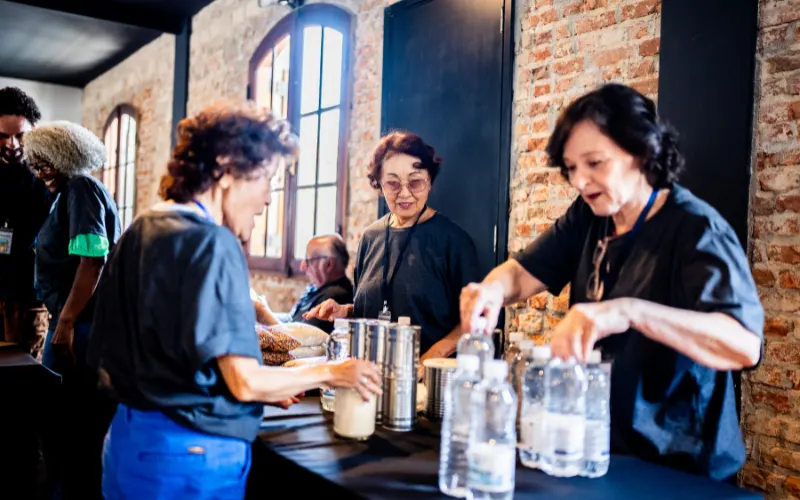
Any expat who attends bazaars organised by community groups will encounter heaps and overflowing tables stacked with gloriously patterned silk and cotton batiks and weavings from every corner of Indonesia. With time, the sheer quantity and variety can feel overwhelming rather than inviting.
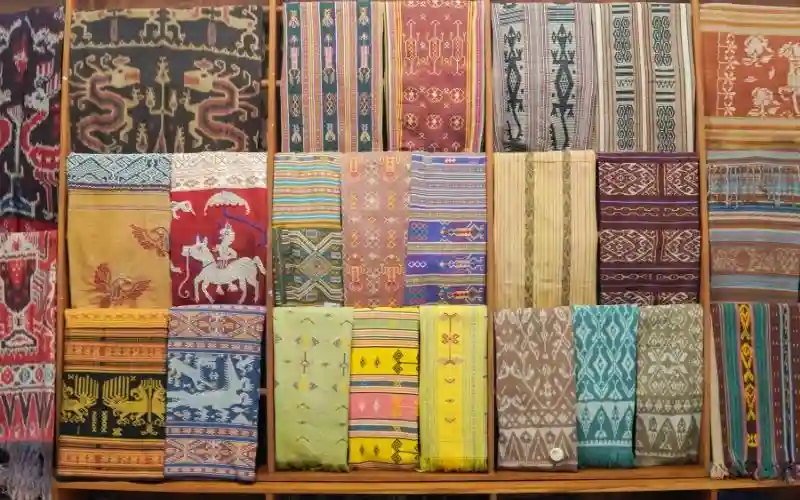
There are Sumatran silks, glowing with scarlet reds and shining golds, and Sumbanese ikat, with rusty reds and deep blues rendered in bold geometric patterns. The colourful rainbow stripes of Timorese ikat contrast with the deeper browns, oranges, and navy of the ikat from Alor, Flores, and Savu. Every colour can be found in the soft cotton batiks of Java — the bright, Chinese-influenced cloths of the north coast, especially from Cirebon and Pekalongan, and the refined browns, whites, and indigos of the court cloths of Solo and Yogyakarta. From Bali there is a veritable explosion of colour and texture, in both traditional ceremonial forms and entirely contemporary design.
With all this variety, how does one choose? Some people buy enthusiastically and regret nothing; others leave Indonesia without ever purchasing one of its most extraordinary products, defeated by the options. The most common barrier is simply not knowing how a cloth is made, what it is used for, or what distinguishes a genuinely fine piece from a mass-produced souvenir. This guide is intended to remove that barrier.
A UNESCO-recognised heritage
Before exploring the regional varieties in detail, it is worth understanding the broader significance of what you are looking at. In 2009, Indonesian batik was inscribed on UNESCO’s Representative List of Intangible Cultural Heritage of Humanity — a recognition that batik is not simply a decorative product but a living cultural practice encompassing knowledge, technique, symbolism, and community identity.
WHY THIS MATTERS WHEN YOU SHOP
The UNESCO inscription is a reminder that the finest Indonesian textiles are cultural artefacts as much as objects of beauty. Buying well-made, genuinely handcrafted cloth — directly from workshops, cooperatives, and weaving communities wherever possible — supports the artisans and families who keep these traditions alive. It is one of the most meaningful things an expat can do with their shopping rupiah.
If you are in Indonesia on or around 2 October, you will observe Batik Day (Hari Batik Nasional) widely celebrated across the country. Government offices, schools, banks, and many private businesses ask staff to wear batik, and the result is a vivid, nationwide display of regional textile diversity. It is an ideal opportunity to see the full range of Indonesian batik styles on display in everyday settings — and to ask colleagues and neighbours about the cloths they are wearing.
Batik tulis, batik cap, and batik print: what you are actually buying
One of the most practically useful distinctions to understand before you shop is the difference between the three main categories of batik. The differences are significant — in technique, time, price, and cultural value.
Batik tulis (hand-drawn batik)
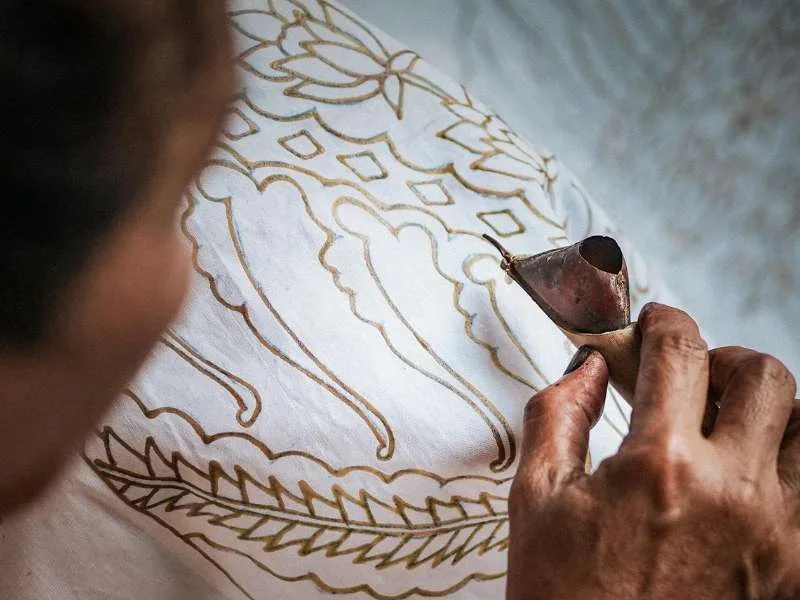
Batik tulis — literally “written batik” — is drawn entirely by hand using a canting, a small copper cup on a wooden handle that allows the maker to apply hot liquid wax in fine, controlled lines. The process is meticulous and slow. Both sides of the cloth must be waxed to prevent the dye from bleeding into unwanted areas. A single length of fine batik tulis from a master workshop in Solo or Yogyakarta may take weeks or even months to complete. The finest pieces are considered works of art and are priced accordingly. Minor irregularities in the pattern are not flaws — they are evidence of human craft and are part of what makes each piece unique.
Batik cap (stamped batik)
Batik cap — “cap” is pronounced “chop” — uses a copper stamp (cap) to apply the wax pattern to the cloth, making production significantly faster and more consistent than hand-drawing. The quality of batik cap can still be very high, and a well-made piece from a reputable producer is an excellent choice for everyday and formal office wear. Many of the batik shirts and dresses sold in reputable shops are batik cap. It is more affordable than batik tulis and entirely legitimate — do not let anyone convince you it is inferior simply because it is not hand-drawn.
Batik print (printed cloth)
Batik print — sometimes called batik printing or batik tekstil — is factory-produced cloth on which a batik-inspired pattern has been applied by screen or roller. No wax is involved at any stage. It is not technically batik at all, though it is widely sold alongside genuine batik and can be difficult for an untrained eye to distinguish. It is perfectly acceptable fabric for casual clothing, but should not be sold or bought at batik tulis prices.
A SIMPLE TEST IN THE SHOP
Hold the cloth up to the light. In genuine batik tulis or batik cap, the wax penetrates fully through the fabric, so the pattern appears with equal clarity on both sides. In batik print, the pattern is present only on one side. You can also look at the reverse side directly: genuine batik will show the same colours and design, not a washed-out or absent version of them.
| Type | Technique | Time to produce | Pattern on reverse? | Relative price |
|---|---|---|---|---|
| Batik tulis | Hand-drawn with canting tool | Days to months | Yes — equally clear | High to very high |
| Batik cap | Copper stamp applied by hand | Hours to days | Yes — clearly visible | Moderate |
| Batik print | Factory screen or roller printing | Minutes per metre | No — pattern one side only | Low |
Nusa Tenggara: selimut, sarongs, and the art of ikat
The islands of eastern Indonesia — Timor, Sumba, Flores, Savu, Alor, and their neighbours — are home to some of the most visually powerful textiles in the archipelago, produced through the ancient technique of ikat. In ikat weaving, the threads themselves are tied and dyed in precise patterns before the cloth is woven, so the design is built into the fabric during weaving rather than applied to its surface afterwards. The result is a textile in which pattern, structure, and colour are inseparable.
Men’s cloths: the selimut
The large flat cloths known as selimut are traditionally worn by men as a wrap-skirt, secured with a belt, with a second cloth of the same size tossed across the shoulder. Historically this was worn without a shirt; today, a collared cotton shirt or t-shirt is commonly worn beneath. An older, thinner selimut is typically worn underneath a finer outer cloth — a practical layering system that also proves useful at the weekly pasar, where it is not unheard of for a visiting textile collector to make an offer on the cloth being worn. Having a decent underlayer makes that proposition considerably easier to consider.
Women’s sarongs
The tubular cloths from this same region are women’s sarongs. They are stepped into, pulled up to the waist or underarm depending on the desired silhouette, and secured by carefully folding and rolling the upper edge. Traditionally worn as a strapless dress — with a selendang, or shoulder cloth, added for formal occasions — or as a skirt with or without a blouse. Today in more remote villages everyday dress remains closely tied to these traditional forms, and visitors should always be respectful and ask permission before photographing people in traditional dress.
Formal dress still consists of a beautifully patterned sarong worn with a fine blouse and selendang. Everyday wear is often an older sarong with a t-shirt — a combination that is comfortable, practical, and visually striking.
A practical note when shopping: sarongs from Nusa Tenggara are frequently pieced in sections, because traditional loom widths are narrow and large cloths are assembled by sewing matching panels together. This is entirely normal and not a sign of inferior quality, but it is worth being aware of if you intend to cut the cloth for a tailored garment.
Java: batik, kain panjang, and the art of the kebaya
In Java, Western clothing is standard for everyday life. Traditional dress is worn for ceremonies, for Friday prayers, and in its relaxed form, at home. The soft cotton tubular sarong — worn in plaids by men, and often in soft floral patterns by women — is cool, comfortable, and ubiquitous for casual and Friday wear.
Tubular sarongs are most commonly worn by older women. Younger women tend to prefer the more figure-flattering kain panjang — literally “long cloth” — a two to two-and-a-half metre length that is wrapped tightly around the waist and hips, with a neat pleat at the front formed by folding the loose end of the cloth.
The central Javanese courts of Solo and Yogyakarta are the acknowledged heartland of fine Javanese batik. Their intricate batik kain panjang in fine cotton are worn by both men and women. For men, the cloth is held in place by a heavy decorative belt; for women, a wide elastic belt is worn underneath and hidden by the folded upper edge of the cloth. Men’s formal dress is completed by a short jacket, often trimmed with gold buttons. Women wear a cotton blouse called a kebaya, over which a batik selendang is draped across the shoulder, often in the same pattern as the kain panjang.
Kebaya styles vary considerably. The most formal versions are made from extremely fine gauze cotton or silk organza with intricate hand-embroidery or lacework cutouts. Older kebaya have no buttons — they were secured with ornate gold or silver pins (peniti). Contemporary kebaya often use buttons or hooks for practicality, and ready-to-wear versions are widely available across the country.
BATIK IN THE OFFICE
Many Indonesian offices, government departments, and international organisations operating in Indonesia observe an informal batik day, typically on Fridays. Expats who wear batik to work are generally met with warmth and appreciation. When in doubt, a batik cap shirt in a darker or more neutral palette reads as appropriately formal in most professional settings.
Sumatra: gold threads, ship-cloths, and the ulos tradition
Sumatra’s textile traditions are as varied as the island is large. The most immediately striking are the richly ornamented cloths of the southern provinces.
Lampung and Palembang
The tubular sarongs of Lampung are among the heaviest in Indonesia, owing to their dense embroidery with gold metallic threads. Because of this weight, the upper portion is typically left plain so the sarong can be folded and tied securely. The men’s and women’s sarongs of the Palembang area are also frequently shot with gold threads; Palembang women’s silk ikat selendang and headscarves, with edges trimmed in gold, are among the most luxurious textiles in the country.
Ceremonial and decorative cloths
Several important Sumatran textiles are not items of clothing but ceremonial and decorative objects. The tirai is a long, brightly coloured hanging with triangular strips, often heavily embroidered and decorated with sequins and small mirrors, displayed for festive occasions. The ship-cloths of the Lampung region — called tampan (small) or palepai (large) — are among the most collectible and valuable of Indonesian textiles. The tampan is used to wrap ceremonial gifts, particularly during weddings. The palepai is hung to decorate the home for ceremonies or celebrations. Both feature stylised ship motifs that are believed to represent the journey between the worlds of the living and the ancestral realm.
The ulos of the Batak people
The ulos is a large woven cloth produced by the Batak people of North Sumatra and carries profound ceremonial significance. During Batak weddings, funerals, and other important life events, specific types of ulos are formally exchanged between family clans. The giving and receiving of ulos is carefully recorded and reciprocated — the type of cloth given communicates the nature of the relationship and the significance of the occasion. An ulos is worn at the shoulder during most Batak ceremonies, including formal weddings in Jakarta, where it may be draped over a suit or formal dress. Expats who are invited to a Batak ceremony should know that receiving an ulos is a significant gesture of welcome and respect.
Bali: ceremony, colour, and contemporary craft
Bali’s textile traditions are rooted in Hinduism and in the island’s extraordinarily dense ceremonial calendar. The kain poleng — a black-and-white checked cloth — is one of the most recognisable Balinese textiles, wrapped around temple statues, sacred trees, and ceremonial objects as a symbol of cosmic balance. The endek, Bali’s own form of weft ikat, produces shimmering, colourful cloth widely used for ceremony and formal dress. Double ikat, known as geringsing, is produced only in the village of Tenganan in East Bali and is among the rarest and most technically demanding textiles in the world — it is dyed in both warp and weft threads before weaving, a process that takes years for a single cloth.

Contemporary Balinese textiles encompass both traditional ceremonial forms and a thriving creative industry producing modern designs for the tourism and fashion markets. The Gianyar district, and in particular the town of Ubud, is a centre for both traditional and contemporary Balinese textile production and an excellent place to see weaving demonstrated and to purchase directly from producers.
Regional textile reference guide
| Region | Key textiles | Technique | Characteristic colours | Primary use |
|---|---|---|---|---|
| Solo / Yogyakarta | Batik kain panjang, batik selendang | Batik tulis, batik cap | Brown, cream, indigo | Ceremonial dress, daily formal wear |
| Pekalongan | Batik pesisir (north coast batik) | Batik tulis, batik cap | Bright multicolour, Chinese-influenced | Dress, decorative cloth |
| Cirebon | Batik mega mendung, batik keraton | Batik tulis, batik cap | Blue gradients, cloud motifs | Ceremonial, court dress, collectible |
| Sumba | Hinggi (men’s ikat), lau (women’s ikat) | Warp ikat | Rust red, deep blue, ivory | Ceremonial dress, dowry, exchange |
| Flores | Ikat sarongs, ceremonial cloths | Warp ikat | Brown, ochre, deep red | Dress, ceremony, exchange |
| Timor | Tais (men’s and women’s ikat) | Warp ikat | Bold multicolour stripes | Dress, ceremony, daily wear |
| Lampung | Tapis (embroidered sarong), tampan, palepai | Supplementary weft, embroidery | Gold on dark ground | Ceremonial dress, wall hangings, gifts |
| Palembang | Songket, silk ikat selendang | Supplementary weft (songket), ikat | Gold and crimson on silk | Wedding dress, ceremonial wear |
| North Sumatra (Batak) | Ulos (various named types) | Warp-faced weaving | Red, black, white | Ceremonial exchange, shoulder cloth |
| Bali | Endek, geringsing, kain poleng | Weft ikat, double ikat, plain weave | Vibrant multicolour; black-and-white (poleng) | Temple ceremony, formal dress, daily wear |
How to buy well
The most important thing to know is that there is no single right place to buy Indonesian textiles — the best source depends entirely on what you are looking for. Community bazaars and markets are excellent for affordable batik cap, printed sarongs, and decorative pieces. Dedicated batik workshops in Solo and Yogyakarta allow you to watch production and buy directly from the maker. Craft cooperatives and weaving villages in Nusa Tenggara offer the best access to genuine handmade ikat, and many welcome visitors. Museum shops — particularly at the Batik Museum in Pekalongan and the Textile Museum in Jakarta — sell authenticated pieces with clear provenance.
When shopping for batik, you may find tubular sarongs offered flat with the final seam unsewn. If you intend to cut the cloth for a garment, always check the dimensions — the standard length is approximately 2.25 metres, but there is variation. You will often be offered a kain panjang with a matching selendang where the pattern is traditionally associated with women’s dress.
For ikat from Nusa Tenggara, look for natural dyes — earthy reds, deep blues, warm browns, and ivory, rather than bright synthetic colours that appear unnaturally vivid. Ask whether the cloth is hand-spun and naturally dyed; these are the most valuable and culturally significant pieces. Tightly woven threads and clear, intentional patterns are further indicators of quality work.
For Sumatran cloths with gold metallic threads, be aware that these threads are brittle and do not respond well to folding. Older cloths in particular may have snapped or frayed threads from being folded for storage or wear in the village — inspect carefully and be sure you can accept any existing imperfections before purchasing.
SUPPORTING LIVING CRAFT
Where possible, buy directly from artisans, workshops, and cooperatives rather than from intermediaries. The price difference is often negligible, but the proportion of the sale price that reaches the maker is dramatically different. Several NGOs and social enterprises operating in Indonesia work directly with weaving communities — particularly in Nusa Tenggara — to provide fair pricing and market access. Their work is worth seeking out.
What to expect to pay
Prices in Indonesian textile markets vary enormously and reflect technique, region, age, and provenance. The figures below are indicative only — please verify current pricing, as these will shift with exchange rates and market conditions.
BATIK CAP
Rp 150,000 – 500,000
Good quality kain panjang from a reputable shop. Office and formal wear standard.
BATIK TULIS (ENTRY)
Rp 500,000 – 2,000,000
Hand-drawn from a Solo or Yogyakarta workshop. Quality and motif complexity determine price.
BATIK TULIS (FINE)
Rp 2,000,000 – 15,000,000+
Master workshop pieces, complex court motifs, fine cotton or silk. Collectible grade.
IKAT (NUSA TENGGARA)
Rp 200,000 – 5,000,000+
Souvenir-grade synthetic-dye pieces at the low end; hand-spun, naturally dyed master work at the high end.
SONGKET (PALEMBANG)
Rp 1,000,000 – 10,000,000+
Fine silk songket with gold thread. Wedding-quality pieces at the upper end.
GERINGSING (BALI)
Rp 5,000,000 – 30,000,000+
Tenganan double ikat. One of the rarest textiles in the world; years of work per cloth.
All prices are approximate and indicative only. Exchange rates, inflation, and individual seller pricing will affect actual costs. Always verify current pricing at point of purchase.
Caring for your textiles
The care a textile requires depends on its technique, fibre content, age, and dye type. The following guidance applies to most traditionally made Indonesian cloths.
Washing: Most traditional Indonesian textiles — particularly batik tulis, naturally dyed ikat, and cloths with supplementary metallic threads — benefit from gentle hand washing in cold water with a mild, pH-neutral soap. Avoid wringing or twisting. Never machine wash fine pieces. Natural indigo and other plant-based dyes can bleed, particularly when new; wash dark pieces separately the first several times. For the most delicate pieces — antique cloths, gold-thread work, geringsing — professional dry cleaning is strongly advisable.
Drying: Dry flat or hang in shade. Direct sunlight will fade natural dyes. Do not tumble dry.
Storage: Store folded cloths with acid-free tissue paper between folds, particularly for pieces with metallic threads, which are vulnerable to cracking at fold lines. Keep stored textiles away from direct light, humidity, and mothballs — cedar blocks are a safer alternative for natural fibre cloths. For long-term storage, a clean cotton pillowcase is preferable to a plastic bag, which traps moisture.
Display: If displaying a textile on a wall, avoid exposure to direct sunlight or proximity to air-conditioning vents. Use a sleeve and rod system rather than pins, which cause damage over time. For large, heavy pieces, consult a textile conservator about appropriate mounting.
Textiles as living tradition
The finest traditional Indonesian textiles have always been understood as assets as much as objects — held by families, brought out for ceremonies, used as dowry items, exchanged between clans in ritualised processes that communicate social relationships and cultural identity. Many of these customs remain very much alive.
During Batak weddings, for example, family clans keep careful account of which types of ulos are given and received, and specific cloths are returned in exchange in a formally choreographed sequence of ceremonies. The ulos given communicates the giver’s relationship to the recipient and the significance of the occasion. An ulos received at such a ceremony is not merely a decorative keepsake — it carries the weight of the relationship it represents.
The economic significance of fine textiles also persists. School fees, funeral costs, and wedding expenses have historically been met by selling prized cloths, and this practice continues in many communities today. When you purchase a fine piece — particularly an older one — there is often a real story behind its availability, and an awareness of that context enriches ownership.
Weaving and batiking remain vital and thriving parts of Indonesian cultural and economic life. The number of young Indonesian designers working with traditional textile techniques and motifs in contemporary fashion has grown markedly over the past decade, and Indonesian batik and ikat now appear regularly on international runways. Buying well, buying with knowledge, and wearing what you buy with genuine appreciation is one of the most direct ways an expat can participate in and support this living heritage.
Where to deepen your knowledge
For those who want to understand Indonesian textiles more deeply before or alongside shopping, the following institutions are worth visiting. Opening status and hours should be confirmed before visiting, as these can change.
Museum Batik, Pekalongan — Widely regarded as Indonesia’s foremost dedicated batik museum, with an extensive collection tracing the development of Pekalongan’s distinctive north coast batik tradition alongside pieces from across the country. Pekalongan is a two-to-three-hour drive from Semarang or can be reached by train from Yogyakarta or Jakarta.
Museum Tekstil, Jakarta (Tanah Abang) — The national textile museum houses a significant collection of traditional cloths from across the Indonesian archipelago. For Jakarta-based expats this is the most accessible starting point for a structured introduction to the full breadth of Indonesian textile traditions.
Museum Sonobudoyo, Yogyakarta — A broad cultural museum with a strong Javanese textile collection set within one of Indonesia’s most important cultural cities. Yogyakarta also has numerous batik workshops that welcome visitors and offer short hands-on sessions — these are among the most rewarding ways to understand the craft.
Weaving villages, Nusa Tenggara — For ikat, nothing replaces visiting a weaving community. Several villages on Sumba, Flores, and Timor are accessible to independent travellers and welcome visitors to observe and purchase directly. Where possible, go with a local guide and buy directly from the weaver.
Frequently asked questions
What is the difference between batik and ikat?
Batik is a surface-dyeing technique in which hot wax is applied to cloth to resist the dye, creating a pattern when the wax is removed. The design is applied to the finished woven cloth. Ikat is a weaving technique in which the threads themselves are tied and dyed in patterns before the cloth is woven — the design is built into the fabric’s structure during weaving. Most Indonesian batik comes from Java; most Indonesian ikat comes from the eastern islands, particularly Sumba, Flores, Timor, and the surrounding region.
Where is the best place to buy batik in Indonesia?
Solo (Surakarta) and Yogyakarta are the heartland of fine Javanese batik, with dedicated batik streets, cooperatives, and workshops where you can observe production and purchase directly. Pekalongan on Java’s north coast is known for more colourful, Chinese-influenced batik. In Jakarta, Pasar Baru and dedicated textile shops in the major shopping centres carry a wide selection. For ikat, weaving cooperatives and village markets in Sumba, Flores, and Timor are the most direct source, though a good selection can also be found in Bali’s Ubud district and at reputable craft shops across the country.
How can I tell if batik is genuinely handmade or machine printed?
Hold the cloth up to the light. In genuine batik tulis or batik cap, the wax penetrates fully through the fabric and the pattern appears with equal clarity on both sides. In machine-printed batik, the pattern is present only on one side. Handmade batik also typically shows subtle variations in the pattern — small irregularities that are evidence of human craft rather than flaws. If the pattern is perfectly uniform and identical across the entire cloth, it is almost certainly printed.
Is it appropriate for expats to wear batik?
Yes, absolutely. Indonesians generally appreciate and welcome non-Indonesians wearing batik — it is considered a gesture of cultural engagement and respect, not appropriation. Wearing batik to a formal event, a Friday office gathering, or a national ceremony is entirely appropriate. For professional settings, batik cap shirts or blouses in darker, more neutral tones are a safe and well-received choice. On Batik Day (2 October), wearing batik is strongly encouraged across all sectors.
What is an ulos and when is it worn?
An ulos is a large woven ceremonial cloth produced by the Batak people of North Sumatra. It carries deep cultural and spiritual significance and is formally exchanged between family clans at weddings, funerals, and other important life ceremonies. The type of ulos given communicates the nature of the relationship between giver and recipient. Ulos are worn as shoulder cloths at Batak ceremonies — including formal events in Jakarta, where guests may drape one over a suit or formal dress. Receiving an ulos at a Batak ceremony is a meaningful gesture of welcome and should be received with appropriate gratitude.
What is geringsing and why is it so expensive?
Geringsing is a double ikat cloth produced exclusively in the village of Tenganan in East Bali. It is among the rarest textiles in the world because it involves dyeing both the warp and the weft threads in complex patterns before weaving — meaning the finished design must be calculated and aligned across two independent sets of threads simultaneously. A single length of geringsing can take years to complete. The cloth is considered to have protective and sacred properties in Balinese Hinduism and is used in certain healing and purification ceremonies. Prices reflect both the extraordinary skill involved and the very limited supply.
How should I store and care for fine Indonesian textiles?
Fine batik tulis, naturally dyed ikat, and cloths with gold or silver metallic threads all benefit from hand washing in cold water with a mild soap, or professional dry cleaning for very delicate pieces. Dry flat in shade — direct sunlight fades natural dyes. Store with acid-free tissue paper between folds, particularly for cloths with metallic threads, which crack along fold lines. Keep stored textiles away from direct light, humidity, and plastic bags. For long-term display, avoid direct sun and air-conditioning vents, and use a sleeve-and-rod mounting system rather than pins.
What is the significance of batik motifs — do they have specific meanings?
Yes, particularly in the court batik tradition of Solo and Yogyakarta. Certain motifs were historically restricted to members of the royal courts and could not be worn by commoners. The parang (diagonal knife-blade pattern), kawung (stylised palm fruit), and sido mukti (prosperity motif) are among the most symbolically significant. Today these restrictions are no longer formally enforced, but the motifs retain cultural weight and are typically worn for ceremonies rather than casually. North coast batik from Pekalongan and Cirebon tends to use more naturalistic motifs — birds, flowers, clouds — reflecting the Chinese, Arab, and European trading influences of those port cities.
This article was originally contributed by Sue Potter, whose expertise in Indonesian textiles informed its foundation. It has been substantially updated and expanded by the Expat.or.id editorial team in 2026.