

“Among the numerous luxuries of the table … coffee may be considered as one of the most valuable. It excites cheerfulness without intoxication; and the pleasing flow of spirits which it occasions…is never followed by sadness, languor or debility.”
— Benjamin Franklin
The statement by Benjamin Franklin has perhaps become more meaningful with time. Little did he know that two centuries later, coffee would evolve from a colonial commodity into one of the world’s most passionately followed beverages — with Indonesia sitting at the heart of that story as one of its most important and storied producers.
Because of its popularity, coffee has become one of the five highest traded commodities in the world. Most of the countries that produce coffee are located close to the equator. Because of its geographical location, Indonesia’s climate is highly suited to the growing and production of coffee. Indonesia consistently ranks among the top four coffee-producing nations in the world, typically third or fourth depending on the season, behind Brazil and Vietnam and occasionally Colombia.
Brief History of Coffee in Indonesia
Coffee was not a native plant to the archipelago. In the 17th century, when Indonesia was still under Dutch occupation, the VOC brought Arabica coffee plants to Indonesia. They were interested in growing the plants and sought to break the worldwide Arab monopoly on the coffee trade.
The Dutch Colonial Government initially planted coffee around Batavia (Jakarta), and as far south as Sukabumi and Bogor. Coffee plantations were later established in East Java, Central Java, West Java, and in parts of Sumatra and Sulawesi. Large areas of forested land were cleared and cultivated specifically for the development of these plantations. The growth of coffee plantations was responsible for the development of a lot of infrastructure in Central Java during the turn of the 19th century. Roads and railways were needed to transport the coffee beans from the island interior to the ports where the coffee was loaded on ships and exported.
Prior to World War Two, Central Java in particular had a very strong rail transportation system that brought coffee, sugar, pepper, tea and tobacco out of the province to the port city of Semarang. Flores and parts of eastern Indonesia were also producing coffee during this period. Although the name Flores is Portuguese in origin — meaning “flowers” — and Portuguese Catholic missionary influence remained strong there culturally, Flores was under Dutch colonial administration by this time. East Timor, however, was a genuinely separate case: it remained under Portuguese colonial rule throughout this entire period, right up until Portugal’s withdrawal in 1975. The Portuguese had introduced Arabica coffee plants to East Timor from a different root stock than what the Dutch had brought to Java and Sumatra — a distinction that would later prove significant, as East Timor is the origin of the Timor Hybrid, a naturally occurring cross between Arabica and Robusta that has since become important in global coffee breeding programmes.
Near the turn of the 19th century a huge portion of the coffee plants in Indonesia, as well as Sri Lanka and Malaysia, contracted coffee rust. Coffee rust is a fungus that produces a fine yellow-orange powdery substance that starts on the underside of the leaves of the plants. This fungus spread very quickly and wiped out entire plantations, devastating the colonial Indonesian coffee industry. The eastern islands were also affected, but not to the same extent that Java was hit, partly because of the different root stock that had been planted there. Some plantation owners did not replant with coffee but opted for tea or rubber trees instead, which they felt were less prone to disease. Many of these plantations still remain in operation today.
The Dutch responded to the coffee rust by importing and planting Liberica coffee. This variety had a short-lived popularity and was also affected by disease. The Liberica cherry can still be found throughout Java but is seldom used as a commercial crop in Indonesia today. The Dutch colonial government then opted for the more resistant Robusta variety to replant the affected plantations. Robusta still makes up around 90% of the coffee crop in Indonesia today.
World War Two and the struggle for independence played a big part in subsequent changes in the Indonesian coffee market. Plantations were taken over briefly by the occupying Japanese forces. After independence, the plantations throughout Indonesia either came under the control of the new government or were abandoned, and many colonial plantation owners fled the country. Today close to 92% of coffee production is in the hands of small farmers or cooperatives.
Coffee Production in Java, Sumatra, Sulawesi and Beyond
Java is one of the largest islands in the archipelago and also one of the largest producers of coffee. Java is renowned for its gourmet Arabica coffee. Arabica is most suited to altitudes over 1500 metres and grows well in temperatures of 16 to 20 degrees Celsius. Arabica plants tend to be more prone to disease, so farmers must pay close attention to the crop while it is growing. Java is also known for producing one of the finest aged coffees in the world — Old Java. Javanese coffee beans can be stored in warehouses for two to three years, which deepens the strong, full-bodied taste that Arabica is known for.
Another major coffee producing island in Indonesia is Sulawesi, which was once known as Celebes. Coffee grown in Sulawesi is mostly processed using the dry method. The most famous coffee growing region in Sulawesi is Toraja, where coffee grows in the mountainous area near the centre of the island, around 1500 metres above sea level. Coffee in the region is grown using traditional practices, mostly on privately owned smallholder plantations. Picking and sorting of the coffee cherries is done by hand, ensuring that only the best cherries are selected. This approach is a natural consequence of the very mountainous terrain and the scattered planting of the coffee trees, which results in a yield of only around 300 kilograms per hectare. Toraja Arabica has a very distinguished character — a full-bodied taste paired with a caramelised aroma and a crisp, clean aftertaste. The soil and the surrounding vegetation of the region contribute significantly to the coffee’s flavour. The low annual yield of Toraja Arabica makes it highly sought after by coffee connoisseurs worldwide, and it is particularly popular in Japan. The highest grades of Toraja coffee are normally reserved for export.
Sumatra is another major coffee producing area of Indonesia. Sumatra produces two of the world’s most famous and high quality coffees — Mandheling and Ankola. Ankola, a name less commonly seen on international packaging today but still recognised among specialty traders, refers to Arabica grown in the Mandailing Natal region of North Sumatra. Sumatra Mandheling coffee is produced outside the city of Padang, in the west coast coffee district. This coffee is characterised by a low-key acidity and a heavy, almost syrupy body with a concentrated and complex flavour. Both of these coffees are dry-processed and are renowned for their unique and rich flavour. Indonesia’s most highly sought after specialty coffees remain the Toraja and the Mandheling.
Several other regional origins have earned significant international recognition over the past decade. Aceh Gayo, grown on the volcanic plateau of central Aceh, is now one of Indonesia’s most celebrated and widely exported specialty coffees. Arabica Wamena comes from the highlands of Papua. Flores Bajawa, from the Ngada Regency highlands, has found a following among specialty buyers for its earthy, chocolatey character. The Kenaliwa range from Papua is also attracting growing attention from international buyers.
Bali, while not among the archipelago’s largest producers, deserves particular mention for the many expats living on or visiting the island. The Kintamani highland region produces a distinctive Arabica that has earned a Geographical Indication certification — one of the first agricultural products in Indonesia to receive this recognition. Kintamani coffee is characterised by a naturally bright acidity and a clean, citrus-tinged finish, a quality partly attributed to the surrounding citrus orchards whose fallen fruit enriches the soil.
Regional Coffee Quick Reference
| Region | Island | Variety | Processing | Flavour Profile |
|---|---|---|---|---|
| Java (Ijen, Dieng) | Java | Arabica, Robusta | Wet / Aged | Full-bodied, earthy, low acid |
| Toraja | Sulawesi | Arabica | Dry / Wet | Full-bodied, caramel, clean finish |
| Mandheling / Ankola | Sumatra | Arabica | Wet-hulled | Heavy body, syrupy, complex |
| Aceh Gayo | Sumatra | Arabica | Wet-hulled | Bright, herbal, full-bodied |
| Kintamani | Bali | Arabica | Wet | Clean, citrus, medium body |
| Bajawa | Flores | Arabica | Wet | Earthy, chocolate, sweet |
| Wamena | Papua | Arabica | Wet | Mild, sweet, low acid |
Coffee Plants
Coffea Arabica, known as Arabica coffee, accounts for 75 to 80% of the world’s coffee production. Coffea canephora, known as Robusta coffee, is more robust than the Arabica plant but produces an inferior tasting beverage with a higher caffeine content. The coffee plant can grow to heights of 10 metres if not pruned, but normally the trees are kept to a reasonable height for easy harvesting. Coffee trees flower twice a year. In Sumatra the season runs from November to January and in Java from late July through to September. The flowers grow in bunches that hang from the tree, though only about 25% of the flowers will grow into coffee cherries. The Arabica species is self-pollinating, whereas the Robusta species depends on cross pollination. After pollination the fruit remains almost dormant for six to eight weeks, after which the cherry enters its rapid growth stage, going from the size of a pinhead to its final cherry size within a fifteen-week period.
Coffee Processing
Once the cherries have reached a level of ripeness where the outer skin turns red, the picking begins. Bigger estates often strip pick using machinery, whereas smaller plantations will hand pick the coffee cherries. Hand picking is the preferred method, as only the best cherries are selected and pest-infected beans and debris can be sorted out at the same time. Freshly picked beans can only last two days before they need to be further processed.
The next stage of processing produces what is known as green coffee. There are two principal methods used to achieve this: the dry method and the wet processing system.
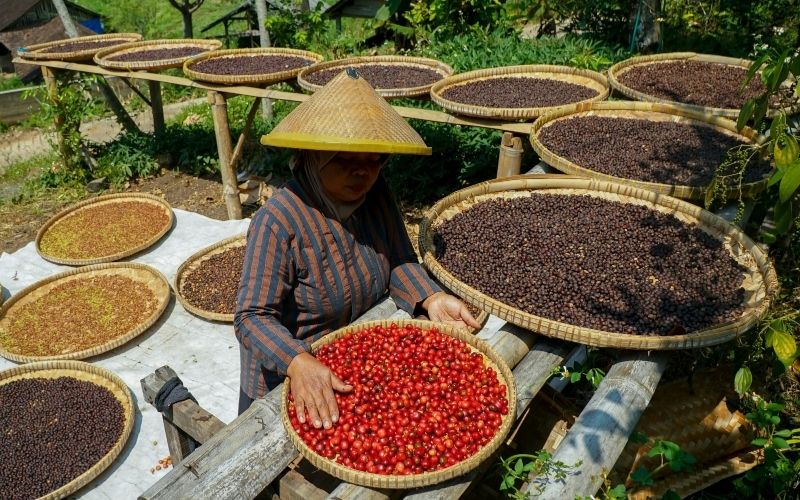
The dry method is predominantly used in Sumatra and by smallholder farmers in Java, Bali, and Flores. This method involves drying the beans outside under the sun, laid out on a concrete pad or on sacking by the roadside. Ideally the stacks of beans should not be more than 5 centimetres high, and the beans need to be turned every two hours to ensure the correct humidity level is achieved before hulling. It is vital that the beans are not rained upon during this process.
The drying process can take several weeks, during which the beans are raked and turned as often as needed to ensure even drying throughout. Once the outer layer of the bean begins to fall away, the coffee is ready to have the pulp removed. The beans are normally dried until their moisture content reaches approximately 11%. The hulling is done by machinery, although some of these machines are still hand-driven. The final product is a green bean, about one third the size of the original cherry. The dry method produces a coffee that is heavy in body, sweet, smooth, and complex.
A third method, unique to Indonesia and particularly common in Sumatra, is wet-hulling, known locally as Giling Basah. In this process the parchment is removed from the bean while it still retains a relatively high moisture content, before a final shorter drying period. This gives Sumatran coffees their characteristically heavy body and earthy, complex flavour — qualities that are a direct result of this distinctive processing technique as much as the bean variety itself.
The wet processing system means the bean can begin the final preparation stage immediately after being picked. Instead of drying under the sun, the cherries are processed through a water system, producing a coffee that is cleaner, brighter, and fruitier. The pulp of the coffee cherries is removed to release the two coffee beans inside, which then sit in water for 24 to 48 hours to ferment. This is the heart of wet processing — where the fine, acidic character of great coffee is developed.
The fermenting process softens the outer skin, making it easy to remove. The system works well, although there are times when the sugars in the beans can over-ferment, affecting the final flavour. Most large coffee estates in Java use wet processing as it speeds up production and generally makes selection of the final green bean much easier. The quality of green bean from wet processing is generally higher.
After fermentation, the remaining pulp is washed off and the beans spread out to dry. The coffee can also be dried in a mechanical dryer powered by wood, gas, or solar power. As with the dry method, the beans need to be dried until the moisture level reaches approximately 11%. The coffee is then referred to as parchment coffee and is ready to be warehoused in sisal or jute bags until readied for hulling.
Machines are used to hull the parchment layer (endocarp) from wet processed coffee. Hulling dry processed coffee refers to removing the entire dried husk — the exocarp, mesocarp and endocarp — of the dried cherries. Green coffee can last for years if stored in the correct conditions. It must not be exposed to high humidity, as this will cause moulding, and it can absorb flavours from items stored nearby, so care must be taken in choosing appropriate warehouse conditions.

Roasting Coffee
Roasting transforms green coffee into the aromatic brown beans we purchase, either whole or already ground, in our favourite stores. Most roasting machines maintain a temperature of about 288 degrees Celsius (550 degrees Fahrenheit). The beans are kept moving throughout the entire process to prevent burning, and when they reach an internal temperature of about 200 degrees Celsius (400 degrees Fahrenheit), they begin to turn brown and the caffeol — the oil locked inside the beans — begins to emerge. The beans must be kept in constant motion so they do not burn or roast unevenly, and they must be cooled, or quenched, at precisely the right moment to achieve the desired roast.
Coffee roasted for too short a time, or at too low a temperature to draw out the oil, has a pasty, nutty, or bread-like flavour. Coffee roasted too long or at too high a temperature becomes thin-bodied, burned, and harsh. Coffee roasted too long at too low a temperature has a baked flavour. The beans are quickly moved into a metal cooling tray where pyrolysis continues until the beans are quenched with either cold air or a light spray of cold water. Most specialty roasters air-quench their coffee.
Some coffee producers do not have their own roasting machines and rely on third parties to roast their beans. During roasting, the water contained in the bean evaporates, making for a lighter yield than what was originally loaded into the roaster. This makes it impossible to verify by weight alone that the beans that went in are the beans that come out. For this reason many producers in Indonesia supervise the entire roasting process, as some less scrupulous operators have been known to substitute inferior beans — or even roasted corn — into the batch. Once corn has been roasted alongside coffee it is almost impossible to detect.
Grinding and Brewing Coffee
To truly get the best taste from your coffee, it is best to grind the beans just before brewing. A good general guide is to use 10 grams (approximately two tablespoons) of ground coffee for each 180ml (6 fluid oz) of water. Keep these proportions consistent regardless of the quantity you are making. Using less coffee and grinding finer makes for a thin, bitter brew. Ground coffee will start to deteriorate within about an hour of grinding, so it is best to grind only what you intend to use immediately. Grind the coffee as fine as possible without losing grounds through the holes in your filter. Never grind it to a powder — completely pulverising the bean destroys the essential oils through the heat and friction of the grinding process. Too fine a grind causes over-extraction and bitterness; too coarse a grind produces watery coffee. The appropriate grind should allow the coffee to finish dripping within several minutes.
Brew with hot but not boiling water. Boiling damages coffee flavour because it vaporises much of the coffee’s aromatic character while continuing to extract bitter compounds. Do not percolate or reheat coffee as it produces much the same effect. Coffee can be kept warm over a low heat for about 20 minutes before the flavour starts to deteriorate noticeably. A water temperature of around 93 to 95 degrees Celsius is ideal — bring the water to the boil and allow it to rest for a couple of minutes before brewing. An insulated air pot or vacuum server is a much better way to keep coffee hot than leaving it on a burner.
Coffee Press
The coffee press is a modern variation on the traditional open-pot style. Hot water is poured over coarsely ground coffee and allowed to steep for approximately four minutes. A mesh filter is then pressed down to the bottom of the pot, separating the coffee from the grounds. The brew is generally considered better quality than drip coffee, as paper filters remove subtle flavours and add a taste of their own.
Drip Coffee Makers
This type of coffee maker is among the most popular and convenient. A permanent metal mesh or synthetic filter will generally improve the taste compared to paper filters.
Espresso Brewing
This method uses pressure rather than gravity to brew. Its popularity has grown enormously, both in commercial settings and for home use. Coffee is loaded into a portafilter and water is forced through it under high mechanical pressure. Most machines also include a steam wand for frothing milk for cappuccino and other milk-based drinks. In Italian, the word espresso means “made to order.” These brewers require a little more practice to master but consistently produce an excellent cup. This method is now standard in the specialty cafés and coffee shops found across Indonesia’s major cities.
Other popular brewing methods include the traditional Italian stove-top moka pot, vacuum brewers, and cold brew extractors.
Enjoying Coffee in Indonesia
Living in one of the world’s great coffee-producing nations, expats have a genuine advantage: the country’s best coffees are right on the doorstep, from roadside warungs to high-end specialty roasters, and many of the finest plantations are accessible to visitors.
Jakarta and other major cities have a thriving café scene, ranging from international chains to a rapidly growing number of outstanding Indonesian-owned specialty roasters and independent cafés. You will find Starbucks, The Coffee Bean and Tea Leaf, and a host of other international brands in malls across the major cities. It is worth noting that while these international chains remain popular, some of the most exciting coffee in Indonesia today is being roasted and served by Indonesian-owned businesses — a reflection of how much the country’s appreciation for its own coffee has matured.
The past decade has seen a genuine specialty coffee revolution across Indonesia. Cities like Bandung, Yogyakarta, Surabaya, Bali, and Makassar now have thriving communities of independent roasters, regular barista competitions, and cafés that showcase single-origin Indonesian coffees with the same seriousness you would find in Melbourne or Tokyo. For expats arriving from coffee-literate cities, the quality and variety available — at a fraction of the price you would pay at home — is one of the more pleasant surprises Indonesia has to offer.
Some of the best coffee can still be found at a small warung kopi — a roadside stall — where kopi tubruk is served in a glass. A visit will certainly be a memorable experience, as traffic whizzes by and the locals try to figure out what a foreigner is doing there. Be forewarned: Indonesians drink their coffee with generous amounts of sugar, and kopi tubruk is served with the grounds steeping in the bottom of the glass. Take that last sip with caution. If you ask for kopi susu (coffee with milk) it may well arrive prepared with sweetened condensed milk, which is an experience in itself. Many people joke that you have to strain the grounds through your teeth — a style sometimes affectionately called “mud coffee.”
One of the most internationally famous — and increasingly debated — coffees from Indonesia is kopi luwak, harvested from the droppings of civet cats. The coffee has a distinctive flavour and was once genuinely rare and difficult to source. It is now widely available in supermarkets and tourist shops across the country. However, expats and visitors should be aware that much of the kopi luwak sold commercially today comes from civet cats kept in caged, intensive farming conditions, which has attracted significant criticism from animal welfare organisations. If you are interested in trying authentic kopi luwak, look for producers who can demonstrate that their civets forage freely in the wild — these producers exist, but they are in the minority and their coffee commands a considerably higher price.
Grocery stores across Indonesia stock a wide variety of locally produced coffees, and specialty shops in the major cities offer the chance to taste freshly roasted single-origin beans from across the archipelago. Whole bean Indonesian coffees also make excellent gifts to bring home — they travel well and offer friends and family a genuine taste of where you have been living. If you are interested in deepening your knowledge, cupping sessions and coffee tastings are now regularly offered by specialty roasters in Jakarta, Bali, Bandung, and other cities.
For those with a taste for travel, coffee agritourism has grown considerably in Indonesia. Plantation visits are now a well-established activity in regions like Toraja, the Gayo Highlands of Aceh, Kintamani in Bali, and the coffee-growing areas around Malang in East Java. Many farms offer guided tours, processing demonstrations, and tastings. A visit to a working plantation remains one of the most rewarding ways to understand where your morning cup actually comes from.
Indonesia’s coffee story is still being written — and as an expat here, you have a front-row seat.
Glossary
| Indonesian | English |
|---|---|
| Kopi | Coffee |
| Kopi pahit | Black coffee |
| Kopi susu | Coffee with milk |
| Kopi manis / kopi dengan gula | Coffee with sugar |
| Perkebunan kopi | Coffee plantation |
| Kopi tubruk | Coffee steeped in a glass with grounds |
| Kopi luwak | Coffee collected from civet cat droppings |
Specialty Coffee Association of Indonesia (SCAI) — www.scai.or.id
The History of Coffee in Indonesia
FAQ
What is the best coffee from Indonesia?
Indonesia produces several world-class coffees, each with a distinct character. Sumatra Mandheling is prized for its heavy, syrupy body and complex flavour. Toraja from Sulawesi is highly regarded for its full-bodied taste and clean finish. Aceh Gayo has earned a strong international following among specialty buyers. The “best” really depends on your palate — Indonesia’s diversity of origins means there is something for every coffee preference.
What is kopi luwak?
Kopi luwak is a coffee made from beans that have been eaten and passed through the digestive system of a civet cat. The process is said to alter the bean’s flavour profile, reducing bitterness and adding a distinctive smoothness. It is one of the most expensive coffees in the world. Visitors should be aware, however, that much commercially sold kopi luwak comes from civets kept in caged conditions, which raises serious animal welfare concerns. Genuinely wild-sourced kopi luwak is rare and considerably more expensive.
What is kopi tubruk?
Kopi tubruk is the traditional Indonesian way of brewing coffee — coarsely ground coffee is placed directly in the glass and hot water poured over it, leaving the grounds to settle at the bottom. It is almost always served sweet. It is the everyday coffee of Indonesia and is found at warungs across the country.
Is Indonesian coffee Arabica or Robusta?
Both. Robusta makes up approximately 90% of Indonesia’s total coffee production and is used widely in commercial blends. However, Indonesia’s most internationally celebrated and highest-value coffees — from Toraja, Sumatra, Aceh, Bali, and Flores — are all Arabica, grown at altitude and prized by specialty buyers around the world.
Where can I visit a coffee plantation in Indonesia?
Coffee plantation visits are possible in several regions. Kintamani in Bali is the most accessible option for many expats. The Gayo Highlands in Aceh, the Toraja region of Sulawesi, and the coffee-growing areas around Malang in East Java all offer plantation experiences, some with organised tours and tastings. The level of formal infrastructure varies — some farms offer polished agritourism programmes while others are simply happy to welcome a curious visitor.
What is the difference between wet and dry processed Indonesian coffee?
Wet processing (also called the washed method) removes the fruit pulp before drying, producing a cleaner, brighter, and more acidic cup. Dry processing dries the whole cherry before hulling, producing a heavier, sweeter, more complex flavour. Indonesia also has a unique third method called Giling Basah or wet-hulling, predominantly used in Sumatra, where the parchment is removed at higher moisture than usual — this is largely responsible for the distinctive earthy, full-bodied character that Sumatran coffees are known for internationally.