

Indonesia’s health system is undergoing a tremendous transformation as it strives to achieve universal free healthcare provision for all Indonesian nationals and, in certain specific cases, for expats also.
This provision of health care to a country of more than 17,500 islands and more than 280 million people has been a huge undertaking. As of 2010, approximately 56% of Indonesians had some form of health insurance. By 2024, BPJS Kesehatan — Indonesia’s national health insurance programme — had enrolled approximately 267 million participants, representing close to 95% of the population, making it the largest single-payer health insurance programme in the world by membership.
These changes have seen the indicators of overall health in Indonesia improving considerably. Life expectancy rose from 63 years in 1990 to 72 years in 2019, and though the COVID-19 pandemic caused a temporary dip, had recovered to approximately 72-73 years by 2023. Under-five mortality rates fell from 84 deaths per thousand live births in 1990 to 23 deaths in 2020. Infant mortality likewise has fallen from 62 deaths per 1,000 live births in 1990 to 19 deaths in 2020.
But the provision of health care still leaves gaps, with some not covered at all and with large disparities between rural and urban populations. At the same time, along with a population whose median age is getting older, lifestyle factors such as overweight, smoking, high blood pressure and high cholesterol are all increasing and placing a greater burden on the healthcare system. These pressures have driven significant government and private sector investment in healthcare infrastructure over the past decade, with the number of hospitals across Indonesia growing steadily and the quality of facilities in major cities now competitive with regional neighbours such as Thailand and Malaysia.
Public and Private Healthcare Hospitals and Clinics
Indonesian health care is a mixture of both public or government funded and run hospitals, and private medical care. Few specialist hospitals are available from the public financed sector, most being available from the private medical care, and most based in Jakarta or other larger cities. Likewise, doctors in the public sector are not particularly well paid and most will have practices within the private sector as well.
Government Health Centers – Puskesmas
There are approximately 10,000 Puskesmas across Indonesia. These provide primary health care at the local level. Reporting through the Ministry of Health, these provide non-emergency care and operate a very wide range of public health programmes. There are two types of Puskesmas: those that have inpatient bed facilities and those that are for outpatients only. These are generally operated by a General Practitioner and a nurse or midwife in attendance. As such, any serious illness or accident is likely to be referred to the nearest hospital immediately.
The Puskesmas are often stretched in the capacity that they have available, and as a result most expats will rely firstly on the private hospital or clinic even for their primary health needs. Whilst Jakarta and other major cities may have good public health care facilities, most public health facilities, and certainly those in rural areas, are in great need of investment, modernisation and improvement of staffing and professional capabilities. Private facilities, on the other hand, tend to be cleaner, more organised, more up-to-date, and more advanced in the technology and professional capabilities that are available. Patient waiting times in the private facilities also tend to be much shorter compared to public facilities.
Your household staff may feel more comfortable going to a Puskesmas, if they are newly arrived from the village. They may also choose to go to a general practitioner’s office for their healthcare needs. Hospitals will have different types of accommodation in wards, some for shared use with several patients in a room, some for two or three patients, and some single occupancy rooms and suites. The room type will determine the pricing of the room and the treatments and procedures, and for most household staff this will be determined through the universal national health insurance scheme of BPJS.
BPJS Kesehatan operates on a tiered referral system: patients are expected to seek initial treatment at their registered Puskesmas or primary clinic before being referred upward to a hospital. Walking into a hospital without a referral is possible in an emergency, but for non-urgent conditions, following the referral pathway will ensure your treatment is covered by BPJS.
Healthcare for Expats
Expats employed within Indonesia are required to join the government BPJS Kesehatan programme. Employers are required to register expat employees for BPJS Kesehatan, typically within 30 days of commencement of employment, and dependent family members living in Indonesia may also be enrolled. The card will be issued to yourself and family members and should be used for any appointment at a Puskesmas or government hospital. As regulations in this area are periodically updated, it is worth confirming the current requirements with your employer’s HR department or directly with BPJS Kesehatan upon arrival.
Most expats will also have health insurance provided by their employer or will opt to take private medical health insurance from one of the many international or local providers. The staff at insurance companies that cater to expats will often be able to speak English, or other languages, and will be able to give advice on all health insurance matters.
When selecting private health insurance, expats should confirm whether their policy includes coverage for medical evacuation. This is a critical consideration for those based outside of Jakarta or Bali, where access to the highest level of specialist care may require transport to another city or even abroad, most commonly to Singapore or Bangkok. Providers such as International SOS and AEA International operate in Indonesia and can be engaged either directly or through employer-arranged coverage.
Costs of Care
Upon arrival at a hospital, medical clinic or health care provider, the registration staff will provide an estimate of expected costs and will confirm with your insurer if a specific procedure is covered. Anything not covered by your insurance you will be expected to pay in full, probably in advance of the procedure.
Private hospital costs in Indonesia remain significantly lower than equivalent treatment in Australia, Europe or North America, and generally lower than Singapore, making Indonesia an increasingly attractive destination for medical tourism as well as routine care. That said, costs vary considerably between facilities and between cities. Always obtain a written cost estimate before agreeing to any procedure, and keep copies of all receipts and medical documentation for insurance claims.
International Healthcare Facility Standards
The newer private hospitals in Indonesia’s larger cities now compete on equal terms with other international hospitals across Asia in terms of facilities, diagnostic technologies, hospital design, patient and family experience and service levels. Some work closely with international collaborative partner hospitals that can guarantee diagnostic accuracy equating to the best international hospitals worldwide, giving more patients the confidence and understanding to choose treatment options in Indonesia.
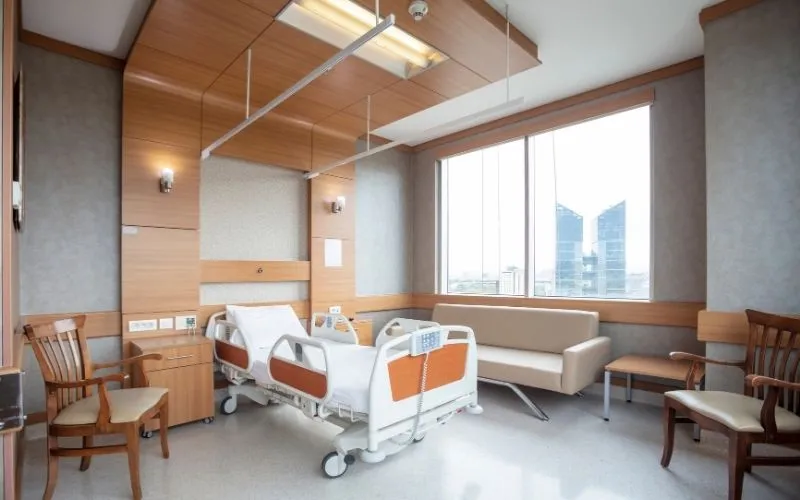
Hospitals will generally have wards accommodating more than one patient, single occupancy rooms, and VIP suites of varying sizes, facilities and pricing. The coverage of your choice of medical room will also be adjusted according to the room type you occupy, so check ahead of time to find out what your medical insurance covers in terms of room type.
It is worth noting that healthcare quality in Indonesia varies significantly by location. Expats based in Jakarta, Surabaya, Bali, Bandung or Medan will generally have access to well-equipped private hospitals with English-speaking staff. Those posted to smaller cities or more remote areas — in Kalimantan, Papua, Sulawesi, or the outer islands — may face a more limited choice of facilities and should factor this into their insurance arrangements and emergency planning. If you are relocating to a regional posting, ask your employer specifically about the nearest accredited private hospital and the company’s medical evacuation policy.
Well-Known Private Hospital Groups
Indonesia has several private hospital networks that expats have come to rely on for consistent quality and English-language service.
Siloam Hospitals is Indonesia’s largest private hospital group, founded in 1996 and part of the Lippo Group. As of 2024, the group operates 41 hospitals across 23 provinces of Indonesia, as well as a network of clinics. Its medical team includes more than 500 general practitioners, 2,200 specialist doctors, and 9,000 nurses and allied health staff, serving close to two million patients annually. Siloam has a presence in Jakarta, Tangerang, Surabaya, Bali, Balikpapan, Makassar, Manado and many other cities, making it the most geographically accessible private hospital group for expats posted anywhere across the archipelago. Among its flagship Jakarta facilities is the Mochtar Riady Comprehensive Cancer Centre (MRCCC) at Semanggi in Central Jakarta, which is recognised as one of the leading cancer hospitals in the Asia Pacific region and offers a comprehensive range of oncology treatments including PET/CT imaging, brachytherapy and advanced radiotherapy.
The RS Pondok Indah Group has been delivering healthcare since 1986 and is one of the most respected private hospital groups in Jakarta. All three hospitals in the group hold Joint Commission International (JCI) accreditation, the internationally recognised benchmark for hospital quality. The group’s three hospitals are located at Pondok Indah in South Jakarta, Puri Indah in West Jakarta, and Bintaro Jaya in South Tangerang. The group is supported by nearly 700 physicians, with the majority being specialists or subspecialists, many of whom have trained or completed fellowships internationally. A fourth Jakarta location is understood to be in planning. The Pondok Indah Group is a natural first port of call for expats based in South or West Jakarta and the wider Tangerang corridor.
MMC Hospital, formally the Metropolitan Medical Centre, is located on Jalan HR Rasuna Said in the Kuningan district of South Jakarta — one of the city’s main expat and diplomatic corridors. MMC has been a fixture of the Jakarta expat healthcare scene for decades and remains a convenient option for those living or working in the Kuningan, Setiabudi and Sudirman areas.
In Bali, BIMC Hospital and Siloam Bali are frequently used by the expat and tourist communities. Rumah Sakit Santosa is a reputable option in Bandung, while Mayapada and EMC are among the newer names building strong reputations in Greater Jakarta.
This is not an exhaustive list, and standards within any hospital group can vary between branches. The best approach is always to ask within your local expat community for current firsthand recommendations, as reputations can and do change with changes in medical staff and management.
Preventative Care
Private sector hospitals in Indonesia offer a full range of preventative health medical check-up packages that are certainly comparable in quality to what is available overseas, and generally at much lower costs. These are well advised on an annual basis, particularly for those in middle to older age groups. A complete medical check-up may also be required by an employer annually.
Dental and optical care are also widely available through private clinics in Indonesian cities and towns and generally represent excellent value compared to home countries. Many expats choose to use their time in Indonesia to address dental work — from routine cleaning and fillings to more significant procedures such as implants or orthodontics — at a fraction of the cost they would pay in Australia, Europe or North America. Ask your local expat community or company HR department for recommendations on trusted dental and optical providers near you.
Doctors are free to work in different clinics and hospitals, but they must be registered to work within a particular facility and cannot work anywhere at random. This is why you will see the same doctor practising at different medical clinics or hospitals.
With pharmacies and pharmaceuticals, there are many regulations in place to safeguard the quality of advertising, distribution and sale of medicines, but there is nonetheless much trade in illegal sale of pharmaceuticals by unlicensed product vendors. Read our article on Apotik/Pharmacies for more information [internal link].
Expats arriving in Indonesia on regular prescription medications should be aware that some drugs readily available over the counter in their home country may be controlled or unavailable locally, while some medications available freely in Indonesian pharmacies may require a prescription elsewhere. If you rely on specific medications, bring a sufficient supply for your initial settling-in period and consult with a local doctor or pharmacist about obtaining ongoing supplies. Bringing medications into Indonesia is permitted for personal use, but quantities should be reasonable and documentation from your prescribing doctor is advisable.
Mobile Technology and Telemedicine
Mobile technology has transformed how Indonesians and expats access healthcare. Appointments with doctors at private hospitals are now routinely made through hospital apps or websites, and test results, radiology images and consultation summaries are increasingly shared digitally. Most of the larger hospital groups have their own patient-facing applications that allow you to book appointments, review test results and manage follow-up care from your phone.

Telemedicine has expanded dramatically, accelerated significantly during the COVID-19 pandemic and now firmly embedded in everyday healthcare habits across Indonesia. Platforms such as Halodoc, Alodokter and KlikDokter connect patients with general practitioners and specialists for online consultations, prescription renewals and laboratory test referrals. These platforms are widely used, generally affordable, and many have English-language support or English-speaking doctors available. For minor ailments, prescription renewals or initial triage before deciding whether to visit a clinic in person, these apps have become a practical first step for many expats. Many Indonesian private hospitals also offer their own telemedicine services for existing patients.
Referrals and Walk-In Admissions
Patients wishing to consult a doctor as an outpatient at a hospital should generally be referred from a primary health care clinic or Puskesmas. In practice, however, many in need of care will turn up to the hospital as walk-in patients. It is advisable to make an appointment beforehand, where appointments are available, to reduce the amount of waiting time on arrival at the hospital. In cases where the hospital does not accept appointments, patients are seen on a first come, first served basis, so depending on how popular the doctor is, there may be a long wait.
Focus on Patient Experience
In choosing a hospital in Indonesia, look for one that focuses on a positive patient experience and international standards. Nothing is more important than the skills of the doctors and care providers, as well as your sense of comfort in the equipment available for diagnosis in the hospital facility.
Many new hospitals in Indonesia feature ultra-modern designs that emphasise bright and light-filled spaces, and patient comfort stands in stark contrast to the traditional view that hospitals are places of doom and gloom. Comfortable patient rooms starting from 40 square metres in size, sleep hubs for waiting family and friends, and design standards contiguous with five-star hospitality reflect the core belief that, in many cases, patient treatment and care can be a positive and uplifting experience.
Look into Options Before You Need Them
In the event you need to be admitted to a hospital in Indonesia during your stay, it would be wise to look into options near your place of work or residence so that you will feel comfortable with your choice of hospital during an emergency or for urgent care. Contact the marketing office of nearby hospitals and ask to take a tour of their facilities.
Many private hospitals in Indonesia actively welcome expat patients and their marketing teams are accustomed to giving facility tours, providing English-language information packs and explaining their insurance billing processes. It is entirely reasonable to visit two or three hospitals in your area before choosing which to register with. Some expat employers will also have a preferred hospital arrangement or a company doctor on retainer — check with your HR department.
Routine Care for Chronic Conditions
The larger city centre hospitals, certainly those in the Jakarta area, will have certain specialty clinics such as Cardiovascular, Cancer, Brain and Spinal, and others. If you are aware of which specialty is relevant to your needs, it is worth researching the hospital that specialises in that area. With the exception of some facilities that focus purely on their specialty, most hospitals are also general hospitals and will have many clinics with associated specialist and sub-specialist doctors in attendance.
Some urban hospitals are also equipped to handle chronic or long-term conditions, with dedicated Diabetes, Geriatric and Rehabilitation clinics, amongst others.
Mental health services, while still less developed than physical health services, are available in Indonesia’s larger cities. Private psychiatrists and psychologists practise in Jakarta, Bali, Surabaya and Bandung, and a growing number offer consultations in English. Teletherapy platforms, including internationally operating services, are increasingly used by expats who find face-to-face options limited or who prefer to work with a therapist familiar with their home culture. If mental health support is a priority, research your options before you arrive and ask your HR department or employer-provided Employee Assistance Programme what provisions are in place.
Accident and Emergency Rooms — Urgent Care
Accident and Emergency departments in Indonesian hospitals are known in Bahasa Indonesia as Unit Gawat Darurat, or UGD. Traditionally these were large open rooms with patients separated by curtains, but newer hospitals pride themselves on a “one room, one patient” model, affording each patient privacy and greatly reduced stress levels. The more modern hospitals will have continuous monitoring of vital statistics at A&E in order to predict and preempt certain critical conditions before they escalate.
How to Get to the Hospital
Emergency ambulance services are provided by a number of companies in Indonesia. These have now largely been consolidated under the national 119 emergency number, but there are still some regional variances.
Ambulances in Indonesia are often staffed only by a driver, with paramedic capabilities varying considerably by location. For cases where an ambulance is not absolutely required, it is often quicker to transport a patient by private vehicle or taxi.
Ride-hailing apps such as Gojek and Grab are widely available across Indonesian cities and can, in genuine non-life-threatening situations, provide a faster response than waiting for an ambulance. However, for serious trauma, cardiac events, difficulty breathing or any condition where the patient may deteriorate in transit, call 119 and wait for professional assistance.
Emergency Ambulance Numbers
119 is now covered by almost all major telephone providers throughout Indonesia and is the primary number to call in a medical emergency.
118 was in use largely in Java and some emergency services still use this number.
If you hold international health insurance or are covered by an employer evacuation programme, your insurer’s 24-hour emergency line should also be among the first numbers you call in a serious medical emergency. They can coordinate hospital admission and, where necessary, arrange medical evacuation to Singapore, Bangkok or your home country.
Other Emergency Numbers
113 — Fire
110 — Police
112 — General emergency (available in most areas)
129 — National Disaster Management
Note: Emergency number coverage can vary by region and telephone provider. Save these numbers in your phone on arrival and confirm any local variations with your employer or local contacts.
Some Indonesian Emergency Words
| English | Bahasa Indonesia |
|---|---|
| Accident | Kecelakaan |
| I have had an accident | Saya mengalami kecelakaan |
| Injured | Terluka |
| Unconscious | Pingsan / tidak sadar |
| Bleeding | Berdarah |
| Heart attack | Serangan jantung |
| Stroke | Stroke |
| Drowning | Tenggelam |
| Burn | Terbakar |
| Very sick | Sangat sakit |
| In labour / having contractions | Mau melahirkan / ada kontraksi |
| I am in labour | Saya dalam persalinan |
| Need a doctor | Butuh seorang dokter |
| Need an ambulance | Butuh sebuah ambulan |
| Emergency | Emergensi |
| Help me | Tolong saya |
| Help! | Tolong |
Frequently Asked Questions
Can expats use Indonesian public hospitals?
Yes. Expats employed in Indonesia are required to enrol in the BPJS Kesehatan national health insurance scheme, which entitles them to use public hospitals and Puskesmas through the standard referral system. Most expats also carry private health insurance and use private hospitals for the majority of their healthcare needs.
Is Indonesian healthcare good enough for expats?
In the major cities — particularly Jakarta, Bali, Surabaya and Bandung — private hospitals now offer facilities and standards comparable to regional benchmarks across Asia. For complex specialist treatment, some expats choose to travel to Singapore or Bangkok, and medical evacuation coverage within your insurance policy is strongly recommended. In smaller cities and rural areas, facilities are more limited.
What is BPJS and do expats need it?
BPJS Kesehatan is Indonesia’s national health insurance programme, covering the vast majority of the Indonesian population. Expats working legally in Indonesia are required by law to enrol. It covers a wide range of treatments at participating public hospitals and clinics, and operates on a tiered referral system starting at the Puskesmas level. Most expats use BPJS as a secondary layer of coverage alongside private international health insurance.
Which hospitals in Indonesia are recommended for expats?
Commonly used and well-regarded private hospital groups include Siloam Hospitals (operating nationally), the RS Pondok Indah Group (South Jakarta, West Jakarta and South Tangerang), MMC Hospital (Kuningan, South Jakarta), BIMC (Bali) and Santosa (Bandung). Always seek current recommendations from your local expat community, as standards can shift with changes in medical staff and management.
What should I do in a medical emergency in Indonesia?
Call 119 for an ambulance. If your condition allows and an ambulance would be slow to arrive, reaching the hospital by private vehicle or ride-hailing app such as Gojek or Grab is often faster. Head to the Unit Gawat Darurat (UGD) — the Accident and Emergency department. If you have international health insurance, call your insurer’s 24-hour emergency line as soon as practically possible, as they can guide you to the most appropriate facility and coordinate any necessary follow-up care.
Is telemedicine available in Indonesia?
Yes, and it is widely used. Platforms such as Halodoc, Alodokter and KlikDokter offer online consultations with Indonesian doctors and are available via smartphone app. Many private hospital groups also offer their own telemedicine services for existing patients.
Can I bring my prescription medications into Indonesia?
Yes, for personal use. Bring a sufficient supply for your initial settling-in period along with documentation from your prescribing doctor. Some medications freely available at home may be controlled or difficult to source locally, so planning ahead before you arrive is strongly advisable.