

There is a scientific technique that has been documented to be widely used by professionals and athletes for attaining peak performance and to give them an edge over the competition. This technique, called neurofeedback or EEG biofeedback, was integrated into NASA astronauts’ space mission training programme for better focus. In addition, performing artists, musicians and scientists use it to enhance their creativity and skills. More recently, elite sports programmes across Europe and the United States have integrated neurofeedback into their athlete preparation routines, with documented use in professional football, golf and the performing arts.
So just what exactly is neurofeedback? In a nutshell, it is a drug-free, non-invasive form of brain self-regulation exercise that essentially does one thing: improve central nervous system function by voluntarily controlling one’s brainwaves to produce beneficial patterns and inhibit undesirable ones. Because every human activity involves the central nervous system, its improvement logically improves every cognitive, emotional and physiological aspect of daily existence.
Neurofeedback’s self-regulation model makes it a compelling therapy modality for the problems of brain disregulation. These typically include, but are not limited to, the anxiety-depression spectrum, attention deficits, behaviour disorders, sleep disorders, headaches and migraines and emotional disturbances. Recent evidence supports neurofeedback’s efficacy when applied to neuro-developmental disorders such as autism spectrum disorder (ASD) — the diagnostic framework that since 2013 has incorporated what were previously classified separately as Asperger’s syndrome, childhood disintegrative disorder and Rett syndrome.
Research on autism spectrum disorder shows that neurofeedback can help remediate irregularities in brain activation, leading to symptom reduction and measurable functional improvement. A systematic review published in the Journal of Psychophysiology in 2021 examined all available controlled and experimental trials and found that 94% reported positive outcomes for neurofeedback in children with ASD. As a result, growing numbers of healthcare professionals now incorporate neurofeedback as a complementary component within broader autism intervention programmes that typically also include speech therapy, occupational therapy and behavioural approaches.
The neurofeedback process
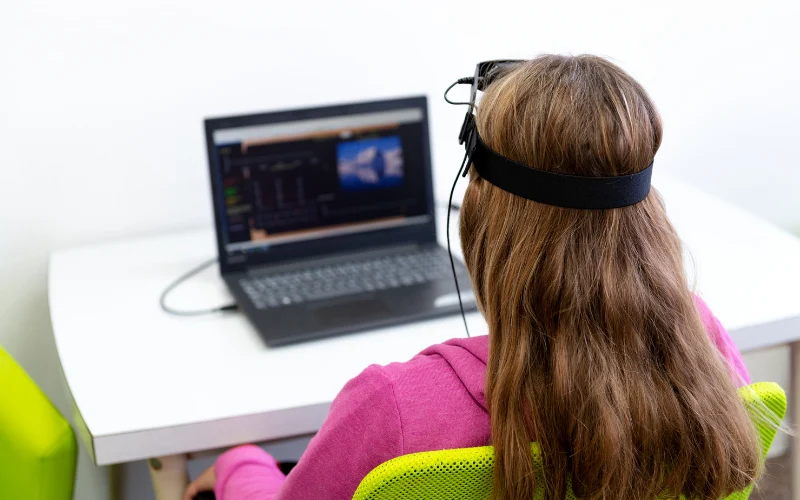
The neurofeedback process involves attaching electrodes (sensors) to the scalp to pick up EEG or brainwave activities. Nothing is actually physically inserted or applied to the brain. Brainwaves are amplified and then presented to the child in the form of a computer game. The child plays the game by creating desirable brainwaves in order to score points in the game. Attempts to mentally control the outcome of the game by thinking, concentrating or even by deliberately trying to relax do not help in generating these brainwaves. The child is instead encouraged to naturally allow the game to proceed by generating the desired mix of brainwaves.
Neurofeedback is based on the principle of operant conditioning, where the award of points and good feelings from successful achievement help the person produce more of the desired brainwaves.
Regulating connections
One way to think of neurofeedback is as a process of regulating and establishing connections that will allow a child to perform at their functional best. Because autism is associated with underconnectivity between parts of the brain, the neurofeedback process endeavours to optimise existing synaptic connections through brainwaves to bring about better regulation and overall improvement in the cognitive, emotional and physiological functions of a child.
Supporting Cases
A body of research over the past two decades has produced empirical evidence attesting to the efficacy of neurofeedback in the treatment of autism. Two of the earlier and most-cited studies are summarised here.
Neurofeedback for Autism: Research on 16 autistic children
In September 2001, Dr. Betty Jarusiewicz of the Atlantic Research Institute presented a scientific paper, Efficacy of Neurofeedback in the Autistic Spectrum.
The study was conducted on 16 children who received neurofeedback for autism, and compared with another 16 controls who did not receive neurofeedback for autism. Here is an excerpt from the study:
Our study involved the training of 16 individuals using neurofeedback, applying a number of assessment processes, and comparing those trained with 16 non-trained individuals.
88% of those trained reduced their levels of autism within months (measured by Rimland’s ATEC check-list) — on average 26% compared with control group on average of less than 5%.
Before and after videos (Greenspan method) were also used for comparison purposes. All results show significant improvement on average in the areas of speech (30%), socialization (34%), other types of health (sleep, anxiety, tantrums — 29%), and cognitive awareness (16%).
As a pilot study with a small sample size, these findings were indicative rather than conclusive, and the authors acknowledged that larger randomised controlled trials would be needed to establish clinical efficacy. The research landscape has since developed considerably, and the overall body of evidence now available is substantially broader than it was at the time of this study.
Neurofeedback for autism: Scientific Paper by Dr Arthur G Sichel, Lester G Fehmi and David M Goldstein
In 2005, Dr Arthur G Sichel and two co-researchers presented a scientific paper titled Positive Outcome With Neurofeedback Treatment In a Case of Mild Autism.
This paper discussed the case of Frankie, an 8½ year old boy who received neurofeedback for autism:
Frankie exhibited a seeming lack of awareness of the existence of others. He did not seek comfort when distressed. He showed no imitation of his siblings and did not engage in social play. His mother reported that he did not vocalise until the age of three, when he began to babble. He did not make eye contact, did not look at the person or smile in social approach. He had a fixed stare in social situations.

Two separate psychologists, each in private practice, one also a school psychologist, diagnosed him autistic. A neurologist specialising in autism, who is on the faculty of a medical school, diagnosed him autistic. A special education professor at a state college said he was autistic-like but brain damaged and said there was no hope for improvement.
As of this writing, Frankie has received 31 sessions of neurofeedback training. His mother reported significant changes after three training sessions. She said he was talking more and had been affectionate with his siblings. For the first time in his life he played with his sister, and even kissed her, and he put his arm around his older brother.
Over the course of training, Frankie’s behaviour continued to change. He began attending to and reacting to others. He started making eye contact. He presented his biofeedback trainers with valentine cards he had made; he appeared shy while presenting them and seemed thrilled when the cards were praised. After 31 neurofeedback sessions he notices his sister’s distress and tries to interfere when she resists taking a bath or going to bed. He seeks comfort when he reads something upsetting. He imitates his older brother and plays with his brother, his sister and a friend.
He no longer tires easily and no longer has trouble falling or staying asleep. His headaches are significantly reduced, as is his tendency to appear anxious and worried. He is much less shy and withdrawn. At this point in treatment, Frankie’s verbalisations are still limited and responses continue to appear slow. He now sometimes makes eye contact and no longer has a fixed, vacant stare in social situations. He engages in a lot of imaginative play with his sister. He now reads with some expression.
He does not speak much and speaks monotonously, but a singsong quality was not present during later sessions. He now refers to himself as “I”. He initiates conversations at home and asks for what he wants. Before, he frequently engaged in a repetitive jumping activity. Now, he rarely does this. Before, he showed great attachment to a number of unusual objects, insisting on carrying them around. He now carries markedly fewer things around with him.
The behavioural changes and the brainwave changes in this 8-year-old autistic boy are viewed as a positive outcome of neurotherapy. These results are suggestive that neurotherapy can be an effective treatment for some of the symptoms of mild autism. It would be interesting to follow possible further gains with additional neurotherapy sessions.
Home training and access in Indonesia
Home-based neurofeedback training is an option that some parents across Indonesia have explored. Although improvements from neurofeedback training have been shown as enduring and sustainable over time, training for autistic children can take months if not years.
Parents considering home neurofeedback training are strongly advised to seek guidance from a qualified neurotherapist or clinical psychologist before purchasing equipment or beginning a programme. Supervision from a certified practitioner is important to ensure protocols are appropriate for the individual child.
In Jakarta, neurofeedback is currently offered at Ciputra Medical Center’s Mind & Behaviour Clinic, located at Lotte Shopping Avenue, Ciputra World 1, which treats conditions including autism, ADHD, anxiety and sleep disorders. Smart Mind Center is another Jakarta-based provider offering neurofeedback alongside psychological assessment and other developmental therapies. Families are advised to contact providers directly to discuss assessment, session numbers, costs and supervision arrangements, as these vary considerably between clinics and individual children’s needs.
Frequently Asked Questions
What is neurofeedback and how does it work?
Neurofeedback, also known as EEG biofeedback, is a non-invasive brain training technique in which sensors attached to the scalp measure brainwave activity in real time. The person — including a child — receives feedback, usually through a computer game or visual display, that rewards the production of beneficial brainwave patterns. Over repeated sessions, the brain learns to regulate itself more effectively without drugs or external intervention.
Is neurofeedback safe for children with autism?
Neurofeedback is widely considered safe. No electrodes or substances are applied to the brain — sensors only measure existing electrical activity. It is non-invasive and drug-free. As with any therapy, families should ensure treatment is delivered or supervised by a qualified practitioner.
How many neurofeedback sessions are needed?
The number of sessions varies considerably depending on the individual child and the goals of treatment. For children with autism, programmes typically involve a minimum of 20 to 40 sessions, and some children continue for considerably longer. Meaningful changes may sometimes be observed within the first ten to fifteen sessions, though this varies.
Where can I access neurofeedback for my child in Jakarta?
Neurofeedback is now offered at a number of clinics in Jakarta, including Ciputra Medical Center’s Mind & Behaviour Clinic at Ciputra World 1. Families are advised to consult with their child’s paediatrician or developmental specialist before beginning neurofeedback, and to ensure the treating practitioner holds recognised credentials in neurotherapy or clinical psychology.
Can neurofeedback replace other autism therapies?
Most practitioners and researchers position neurofeedback as a complementary therapy rather than a standalone treatment. It is typically used alongside speech therapy, occupational therapy and behavioural approaches. The combination and sequencing of therapies should be discussed with your child’s treatment team.
Is neurofeedback covered by Indonesian health insurance?
This varies by provider and policy. Families with international health insurance should check their policy for coverage of complementary or neurological therapies. Ciputra Medical Center accepts a range of insurance plans — verify directly with the clinic for current arrangements.
This article was originally contributed by Thio Chong, a registered psychologist (NSW Psychologists Registration Board, Australia) and founding director of the Autism Support Network in Singapore, and has been updated and reviewed by the expat.or.id editorial team.
This article is intended as an introduction to neurofeedback therapy and is not a substitute for personalised medical advice. If you have concerns about your child’s development, please consult a qualified healthcare professional.