

Overview
Gastrointestinal infections remain a significant health challenge in Indonesia, posing a public health concern due to factors such as waterborne pathogens, inadequate sanitation, and limited access to healthcare in certain regions. The condition is influenced by various socio-economic factors and health system capabilities. Typhoid and Hepatitis A are among the most common gastrointestinal infections in Indonesia.
Statistics
According to the Ministry of Health, gastrointestinal diseases are prevalent across the country, with a substantial number of cases reported annually. The Indonesian archipelago’s tropical climate and high population density contribute to the spread of infectious diseases, including those affecting the gastrointestinal tract. Rural areas, in particular, are more susceptible due to less developed sanitation infrastructure and clean water access.
The Health Statistics Profile 2023 published by BPS-Statistics Indonesia found that among acute diarrhea cases, a significant percentage of patient stools were positive for bacteria. The most prevalent pathogen isolated was Shigella flexneri, followed by Salmonella sp. and Vibrio sp.
Diarrhea is an endemic disease in Indonesia with the potential to cause outbreaks, and it remains a contributor to mortality statistics — especially in children. Health Research in 2018 stated the prevalence across all ages is 8%, with children aged 1–5 years at 12.3% and infants aged 0–12 months at 10.6%. Diarrhea accounts for 5.8% of deaths in children aged 1–5 years.
In Indonesia, the incidence of typhoid fever is estimated at 350 to 810 cases per 100,000 population, with fatalities estimated at 50,000 per year. Indonesia is classified by the WHO and Global Burden of Disease study as a high-incidence country for typhoid fever, alongside other Southeast Asian nations such as Bangladesh, the Philippines, and Vietnam. A recent geospatial study drawing on confirmed hospitalized typhoid case data from 200 hospitals and 333 primary health centers across Jakarta (2017–2023) found that true community prevalence is likely higher than reported, as typhoid closely mimics dengue and malaria in early presentation, leading to clinical misdiagnosis.
Typhoid fever necessitates prompt antibiotic therapy to effectively eradicate the Salmonella Typhi bacteria, while management of Hepatitis A primarily involves supportive care, as the body’s immune system typically clears the virus without the need for antiviral medications.
Antimicrobial Resistance: A Growing Concern
Indonesia is facing a significant burden of antimicrobial resistance (AMR). According to the Institute for Health Metrics and Evaluation, in 2019 there were 34,500 deaths attributable to AMR and 133,800 deaths associated with AMR in Indonesia. Indonesia has the 78th highest age-standardized AMR mortality rate per 100,000 population across 204 countries worldwide, and the 5th highest across 13 countries in Southeast Asia.
This challenge is directly tied to typhoid management. Because adequate laboratory diagnosis is lacking in most rural health facilities, antibiotics are commonly prescribed to patients based on clinical suspicion alone. This symptom-based approach accelerates antimicrobial resistance, a pattern serious enough that the WHO has listed Salmonella spp. as a high-priority pathogen facing antibiotic resistance.
Background
Historically, gastrointestinal infections in Indonesia have been linked to several factors:
- Unsafe water sources: Many communities rely on water sources that are not adequately treated, leading to contamination.
- Inadequate sanitation: A lack of proper waste disposal systems and toilets facilitates the spread of infections.
- Cultural practices: Certain local customs and food preparation methods may increase the risk of transmission.
Most Common Cases
The most common gastrointestinal infections in Indonesia include:
- Typhoid fever: Caused by Salmonella Typhi, transmitted through contaminated food and water.
- Cholera: An acute diarrheal infection caused by ingestion of food or water contaminated with Vibrio cholerae.
- Hepatitis A: A viral liver disease that can cause mild to severe illness, spread through the consumption of contaminated food or water.
Recommendations
The Indonesian government, through the Ministry of Health, has issued several recommendations to combat gastrointestinal infections:
- Improve water and sanitation facilities: Ensuring access to clean water and promoting the construction of adequate sanitation facilities.
- Public health education: Educating the public on proper hygiene practices, such as handwashing and safe food preparation.
- Vaccination programs: Implementing vaccination drives for preventable diseases like typhoid and hepatitis A.
- Strengthening healthcare systems: Enhancing the capacity of healthcare facilities to manage and treat infections effectively.
Vaccination Strategy
Hepatitis A and Typhoid vaccinations are crucial tools in the health strategy, offering protection against two significant causes of gastrointestinal infection. Both diseases are transmitted through the oral-fecal route — meaning they can enter the body when an individual ingests food or water that has been contaminated with the feces of an infected person.
Hepatitis A is primarily spread by ingesting food or water contaminated with feces from an infected person. It can also spread through direct contact with an infectious person. The virus is robust and can survive in the environment for extended periods, making it highly transmissible in poor hygiene and sanitation conditions.
Typhoid Fever, caused by the bacterium Salmonella Typhi, is also spread through contaminated food and water. It can be contracted by eating food handled by someone who is infected, or if sewage contaminated with the bacteria gets into the water used for drinking or washing food.
Vaccines for Hepatitis A and Typhoid are recommended by the Indonesian Pediatric Society (IDAI) and the Indonesian Internal Medicine Society (PAPDI), for travelers as well as people living in Indonesia, and the general population — especially in areas where the diseases are more prevalent.
The World Health Organization (WHO) recommends Typhoid vaccination in endemic areas, which can include food handlers as a targeted group. The CDC has also noted the role of food handlers in Hepatitis A virus transmission and suggests that vaccination efforts should be prioritized where the risk of secondary transmission is high.
Typhoid Vaccines Available in Indonesia
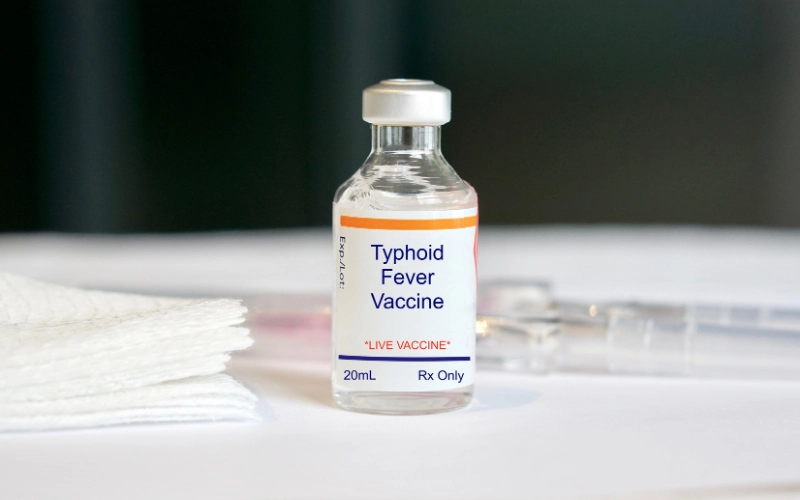
Typhoid vaccination prepares the body’s immune system to recognize and fight off Salmonella Typhi by stimulating the production of antibodies. There are two main types of typhoid vaccines:
- Inactivated Vaccine: Uses a killed version of the bacteria to stimulate the immune response without causing disease. Administered as an injection, it provides 2–3 years of coverage.
- Live Attenuated Vaccine: An oral vaccine using a weakened form of the bacteria that cannot cause illness in healthy individuals. It provides 5–7 years of coverage.
A significant development for Indonesia’s long-term typhoid prevention strategy came in November 2023, when Indonesia’s national regulatory authority (BPOM) approved Bio-TCV®, a domestically produced typhoid conjugate vaccine (TCV) developed by Bio Farma, a state-owned manufacturer based in West Java. Initially developed at the International Vaccine Institute and technology-transferred to Bio Farma in 2014, Bio-TCV® is a Vi polysaccharide vaccine conjugated to a diphtheria toxoid carrier protein, approved for use in individuals from 9 months to 45 years of age. This locally manufactured vaccine supports Indonesia’s broader immunization goals and reduces dependence on imported vaccines.
Hepatitis A Vaccine
In Indonesia, Hepatitis A vaccines are available and recommended for travelers and high-risk groups. The vaccine is administered in two doses as an injection for effective long-term protection. Research has shown that Hepatitis A vaccines are safe and effective, and since their introduction, there has been a significant decline in Hepatitis A cases.
Vaccine schedules for children and adults are available via the IDAI and PAPDI recommendations: IDAI Children’s Immunization Schedule and PAPDI Adult Vaccination Schedule.
Conclusion
Gastrointestinal infections pose a significant health burden in Indonesia. While the government has made strides in addressing these issues, ongoing efforts are required — through a combination of improved infrastructure, public health education, vaccination, and effective surveillance.
Hepatitis A and Typhoid vaccinations are crucial tools in this health strategy. The Hepatitis A vaccine is a safe and effective means to prevent a virus that can cause debilitating liver disease, while the Typhoid vaccine guards against a bacterial infection that can lead to severe systemic illness. The recent approval of a domestically produced typhoid conjugate vaccine further strengthens Indonesia’s capacity to tackle this endemic disease.
About SOS Medika
For almost 40 years in Indonesia, SOS Medika has provided round-the-clock services of family physicians, specialists, and emergency support, as well as in-house pharmacy, imaging, and laboratory. With a strong focus on holistic care and disease prevention, SOS Medika offers a wide range of vaccinations including Hepatitis A, Typhoid, Influenza, Yellow Fever, and more.
Let’s get vaccinated!
For any medical assistance, contact our clinics. We are committed to providing prompt care 24/7.
SOS Medika Cipete
Jl. Puri Sakti no. 10, Cipete Selatan – Antasari, Jakarta Selatan 12410
Tel: +62 (0)21 750 5980 | Email: [email protected]
Operating hours: 24 hours including Public Holidays
SOS Medika Kuningan
Menara Prima 2nd Floor, Jl. DR Ide Anak Agung Gde Agung, Blok 6.2, Kawasan Mega Kuningan, Jakarta 12950
Tel: +62 (0)21 5794 8600 | Email: [email protected]
Operating hours: Mon–Fri: 8AM–5PM | Saturday: 8AM–2PM
International SOS, Bali
Jalan By Pass Ngurah Rai No. 194, Sanur Kaja, Denpasar, Bali 80227
Clinic Tel: +62 (0)361 2014 505 | Email: [email protected]
24-Hour Assistance Centre: 0361 710 505
Operating hours: Mon–Fri: 8AM–10PM (including Public Holidays)
We trust this information will assist you in making the right choices regarding your health and welfare. However, it is not intended to be a substitute for personalised advice from your medical adviser.
Our appreciation to the Coordinating Doctors of International SOS, an AEA Company, who contributed this article in response to a health threat faced by expatriates in Indonesia.
Original article last updated July 18, 2024. Updated with additional data June 2026.