

Editor’s Note:
This article explores the history and cultural significance of the kebaya, one of Indonesia’s most recognizable traditional garments. While the historical context remains accurate, styles, materials, and modern usage continue to evolve. For formal events, cultural celebrations, or official functions in Indonesia today, the kebaya remains an important and respected form of dress for women.
The kebaya is one of Indonesia’s most iconic forms of traditional dress, worn by women across the archipelago for generations. For expats living in Indonesia, understanding the kebaya is more than just learning about clothing. It offers insight into the country’s history, social structure, and evolving cultural identity. Whether seen at formal events, weddings, or national celebrations such as Kartini Day, the kebaya remains a powerful symbol of Indonesian heritage.
History of the Kebaya
There is much speculation as to where the kebaya could have originated from. There are some who say that the kebaya originated in the Middle East, while others argue that it may have come from nearby China. Derived from the Arabic word kaba meaning “clothing” and introduced to Indonesia via the Portuguese language, the term kebaya has come to refer to a garment whose origins appear to be a blouse. It was first worn in Indonesia at some time during the 15th and 16th centuries.
This garment is similar to what is described as a long, fitted, flared kebaya known as kebaya panjang, worn in the 16th century by Portuguese women arriving on the south-western coast of Malaysia, situated across the Malacca Straits from Sumatra, in northwestern Indonesia.
Many sources also cite Chinese influences on clothing of the time, with comparisons to an open-fronted long-sleeved tunic worn by women of the Ming Dynasty. The introduction of this kind of dress is often attributed to two major influences of the time: the spread of Islam and the arrival of Europeans in the archipelago. Whether it was Arabia or China that brought us the kebaya, there is no denying how quickly this garment became uniquely Indonesian, spreading across islands and ethnic groups, each developing its own regional variations. This diffusion was also linked to the spice trade that connected the region.
Origins of the Kebaya
After Dutch colonization, the kebaya took on a new role as formal dress for European women in the country. During this time, the kebaya was made mostly from mori fabric. Later modifications introduced the use of silk and embroidery to add design and colour.
The most dominant form of kebaya worn on the islands of Java and Bali today can be traced to styles from the late 19th to early 20th century. Many of the recognizable features of today’s kebaya, such as the fitted silhouette, collarless neckline, front opening, and long sleeves, were already present at that time.
Traditionally, the torso was wrapped with a long piece of cloth called a stagen. Women of higher social status often had assistance when dressing, while others would secure the cloth themselves. The semi-transparent kebaya blouse was then worn over the top of the stagen and fastened with a brooch rather than buttons.
It was customary to combine the kebaya with a kain, a length of unstitched cloth worn on the lower part of the body, often incorrectly referred to as a sarong. The kain was wrapped with pleats placed at the front and was traditionally dipped in a cornstarch solution and carefully pressed to achieve a crisp, structured look.
Today, while the kebaya retains its traditional structure, it has adapted to modern lifestyles. Contemporary designs may include zippers instead of brooches, lighter fabrics for comfort, and simplified silhouettes that are easier to wear without assistance.
Indigenous Dress in the Making of a Nation
Considering the enormous historical, political, and social shifts that have occurred in Indonesia over the last century, the form of the kebaya has remained relatively unchanged. Its function and meaning, however, have evolved significantly.
The kebaya has come to symbolize the emancipation of women in Indonesia, particularly through its association with the 19th century figure Raden A. Kartini.
During the 19th century and prior to the nationalist movement of the early 20th century, the kebaya was worn by Indonesian, Eurasian, and European women alike, with variations reflecting class and status. Javanese royalty wore silk, velvet, and brocade, while commoners wore patterned cotton. Eurasian women often wore white cotton kebaya trimmed with European lace, while Dutch women preferred shorter white versions.
Bali’s Kebaya
In Bali, the kebaya has a more recent history. Dutch influence in the 19th century is believed to have encouraged or enforced its use. Prior to this, Balinese women often left the upper torso uncovered except during ceremonial occasions.
By the early 20th century, the kebaya had become widely adopted in Bali, spreading from royal courts into broader society. While clothing often reflects social hierarchy, there is little evidence that strict caste-based rules governed kebaya styles. Differences were more likely tied to wealth and access to materials.
Emerging as National Dress
By the 1920s, as Indonesian nationalism grew, European women stopped wearing the kebaya, as it had become strongly associated with Indonesian identity.
During the Japanese occupation (1942–1945), Indonesian women prisoners chose to wear kain-kebaya instead of Western clothing as a statement of cultural identity. This further strengthened the kebaya’s symbolic role.
At Indonesia’s Proclamation of Independence on August 17, 1945, Ibu Trimutri, the only woman present, wore a kain kebaya. This moment helped elevate the kebaya to the status of national dress.

For expats, the kebaya is most commonly encountered at formal occasions such as weddings, embassy events, official ceremonies, and cultural celebrations. It is also widely worn during Kartini Day, when Indonesian women honour the legacy of Kartini.
From the Palace to the Street – Popular and Traditional Images
The kebaya is worn by women across all walks of life, from former President Megawati to jamu vendors in traditional markets. While it cannot be considered a social leveller, it is a powerful cultural symbol that transcends generations.
In modern Indonesia, the image of a woman in kebaya is often used in advertising to evoke tradition, purity, and authenticity. For many older women, particularly those in traditional occupations, the kebaya remains daily attire.
It is important to understand that the kebaya reflects social context. In formal settings, fabric quality, tailoring, and accessories often indicate the occasion and level of formality. Today, however, it is also embraced as a fashion statement.
Today’s Kebaya
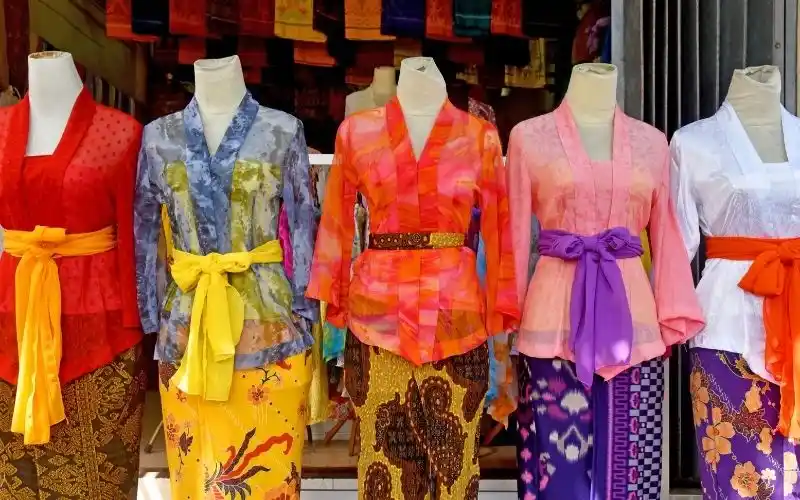
If we try to define what a kebaya is today, it can be challenging, as it continues to evolve with fashion trends. Most kebaya are made from lace or brocade and often feature floral motifs. The length can vary from above the waist to below the knee, and it typically has long sleeves and a front opening.
The quality of the kain worn with the kebaya is an important element of the overall look. Hand-made batik is generally considered more valuable than printed fabric, and the style and pattern of the batik often reflect the region it comes from. This is an important part of cultural identity, and knowledgeable observers can often identify the origin of a garment based on its design.
A selendang (sash) is sometimes worn as an accessory and is typically chosen to complement or match the batik kain. Together, these elements create a coordinated and culturally meaningful appearance.
When worn for formal occasions, the kebaya is not simply a garment but part of a complete presentation. Hair styling and makeup are carefully considered, and the overall look is expected to be polished and elegant. This attention to detail reflects both personal pride and respect for the occasion.
In recent years, the kebaya has experienced a revival, with modern designers reinterpreting it using contemporary cuts and fabrics. It remains a popular choice for weddings, official events, and high society gatherings.
For expats who may need to wear a kebaya, there are practical options available. Tailors and boutiques in major cities offer custom-made pieces, while rental services provide an accessible option for one-time use.
While wearing a kebaya is not expected of expats, doing so is often appreciated when attending formal or cultural events. It is important to wear it respectfully, ensuring proper fit and coordination. Local guidance can be very helpful in achieving an appropriate look.
Understanding the Components
For those new to Indonesia, it is useful to understand the different elements associated with the kebaya:
- Kebaya refers to the blouse
- Kain refers to the wrapped skirt
- Batik refers to the fabric pattern or technique
Understanding these distinctions helps avoid common misunderstandings.
Frequently Asked Questions About the Kebaya
What is a kebaya?
A kebaya is a traditional Indonesian blouse worn by women, typically paired with a kain and often made from lace, silk, or brocade.
When do women wear kebaya in Indonesia?
Kebaya is commonly worn at weddings, cultural ceremonies, national celebrations, and formal events.
Do expats need to wear kebaya?
No, but many choose to wear it for formal or cultural occasions as a sign of respect and appreciation.
Can I rent a kebaya in Indonesia?
Yes, rental services are widely available in major cities and are a convenient option for expats.
What is the difference between kebaya and batik?
Kebaya is the blouse, while batik refers to the patterned fabric often used in the kain.
This article was written by Gene Sugandy, with research from the following sources:
Reading the Kebaya by Victoria CattoniKebaya – Wikipedia