

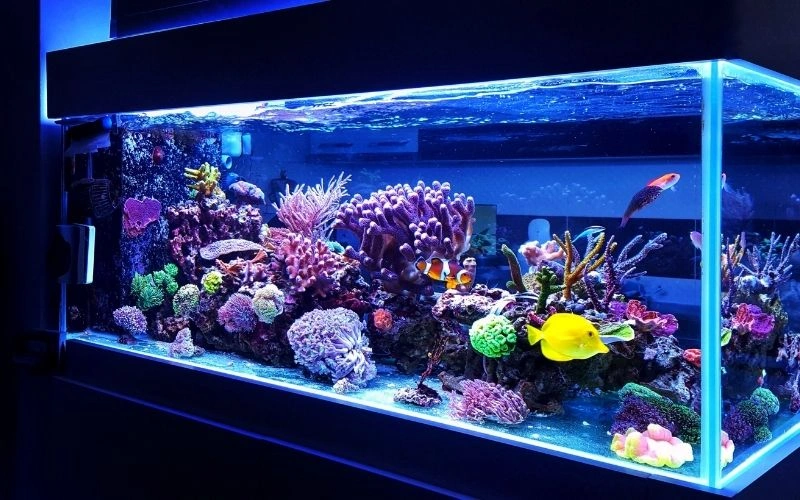
This article describes the steps taken to ensure a top-quality reef aquarium system, with advice given on all aspects of the system, and also a section on the methods used by both reputable and unscrupulous suppliers to the trade.
Many expatriates, at one time or another, have looked at marine aquariums in their home country, but been put off by either the high cost or the high level of maintenance required. Some expatriates purchase marine aquariums in Indonesia, as there is an abundance of outlets providing them. Many of the people we have spoken to or dealt with have bought their aquarium system at a bargain price as an “executive stress reliever”. Instead of stress relief, they only find that it creates more stress, when they see their fish and corals die rapidly and regularly, only to be told “The water is too cold”, or “It’s normal for your fish to die” or “You need to buy this, that and the other” by an unqualified aquarium maintenance firm.
The truth of the matter is, good-quality filtration, lighting, and water movement are of paramount importance, and should be provided right from the start, as should quality fish and corals (inverts). Let’s start at the very beginning!
Selecting a Tank
To reduce potential problems with water management, the first step is to select an aquarium as large as you feel you can accommodate. The greater the volume of working water, the more stable the conditions will remain, thus enabling you to duplicate a natural reef environment more closely. The tank dimensions should not be less than 100cm (40 in.) long x 70cm (28 in.) deep x 70cm (28 in.) wide. In volume terms, this is equivalent to approximately 600 liters or 156 U.S. gallons.
Glass or acrylic aquarium? Glass, although heavier, is less prone to scratching when cleaning. Acrylic, on the other hand, is more durable and is not restricted to being square or rectangular in shape. Good acrylic designs are available from European and Japanese manufacturers at the premium end of the market, and a much wider range of mid-range acrylic tanks is now available from manufacturers elsewhere in Asia, making this option more accessible than it once was. That said, availability in Indonesia still varies considerably depending on where you are based, and Jakarta and Bali remain the most reliable cities for sourcing specialist aquarium equipment.
Cabinet for your aquarium? Given the fact that some expats reside in Indonesia for two to three years, it is worthwhile to consider purchasing a good quality cabinet. Well-crafted cabinets are relatively inexpensive in Indonesia when compared to many other countries. The glass can be dismantled and flat-packed, and shipped home with the cabinet, pumps and lighting system in their original containers, then re-assembled back home. Some expats do consider the purchase of a marine aquarium in Indonesia as something of an investment.
One important point worth raising here: shipping the equipment home is relatively straightforward, but transporting live coral and fish internationally is an entirely different matter. It requires CITES export documentation, specialist livestock packaging, and prior approval from the airline. Some expats discover this only when they are already planning their departure. If you intend to take livestock home with you, begin researching the process well in advance — it cannot be arranged quickly or cheaply, and the requirements are strict.
Water Temperature
Many books and articles advise that a healthy marine system containing fish, corals and plants requires temperatures of 23-25°C (73-77°F). For the Indo-Pacific species that are available in Indonesia, some aquarium owners have found, through considerable trial and error, that the temperature should be 24-25.5°C (75-78°F) with the optimum temperature being 25°C (77°F). The lower end of this scale is predominantly for coral tanks and the upper end for aquariums predominantly populated with fish.
Also, with respect to lighting, ensure that the hood is well ventilated so as not to warm the water too much. This is especially important because the level of dissolved oxygen in the water decreases with a rise in temperature, thus leading to respiratory problems in fish and corals.
The most reliable way of keeping the temperature constant is to use a chiller — effectively a refrigeration unit specifically designed for aquarium use. Chillers are not cheap, but when you see the difference in how much the corals open up and how healthy they become, the cost is quickly offset by not having to replace livestock regularly and not having to run your home air conditioning around the clock. Entry-level chillers suitable for a tank of the minimum recommended size currently start at roughly USD 300-500, with quality units from established brands running USD 600-1,200 or more. These figures are a general guide only and the market fluctuates, so verify current pricing with local suppliers before purchasing.
If your water temperature rises above 27°C, there is far less dissolved oxygen in the water and the corals become bleached and rapidly die. A reliable chiller is therefore not a luxury — it is one of the most important investments you will make in the system. Aquarium owners who maintain a consistent temperature report considerably better long-term results with coral health and longevity.
Filtration
Filtration is an essential element for marine reef aquariums, and really in-depth information could make up a book by itself. The following is a brief outline of the objectives of filtration, with recommendations for the most effective and practical setup.
Understanding the Nitrogen Cycle
Simply put, the nitrogen cycle involves the breaking down of nitrogen-bearing organic compounds into simpler substances, carried out by specific bacteria. The metabolic processes of fish and the decay of uneaten food first produce quantities of ammonia, which is quite harmful to fish and many other marine organisms. Fortunately, specific bacteria break the ammonia down into nitrites, although these are still dangerous to fish.
The nitrites are then broken down by yet another group of bacteria into nitrates, which are more easily tolerated than the two other substances. Algae and plants in marine aquariums utilise the nitrates in their metabolic processes; however, this does not happen quickly enough that nitrate levels can be ignored, so they should be carefully monitored.
Methods of Filtration
The pros and cons of various filtration systems have been debated hard and long. Many marine inverts and animals are very sensitive to water conditions, and good filtration is the secret to successful reef-keeping. There are three main categories of filtration: mechanical, chemical, and biological.
| Filtration Type | How It Works | Primary Benefit |
|---|---|---|
| Mechanical | Physical trapping of waste particles via filter floss or sponge | Prevents clogging of other filter media |
| Chemical | Active carbon absorbs dissolved waste ions | Removes harmful compounds before they enter the nitrogen cycle |
| Biological | Beneficial bacteria colonise filter media and break down ammonia and nitrites | Core long-term water quality management |
Mechanical filtration traps and removes suspended matter — waste products — and prevents chemical and biological filters from becoming clogged with debris. The most common form is spun nylon floss.
Chemical filtration is usually based on active carbon, which has the capacity to absorb the ions from dissolved waste onto its large surface area. It also harbours some of the bacteria responsible for breaking down potentially harmful ammonia and nitrites.
Biological filtration comes in a variety of forms. It cleanses the water by harnessing the biochemical properties of living bacteria to break down waste. Systems range from undergravel filters, which use the tank substrate as a filter bed, to more complex yet surprisingly manageable arrangements. The more advanced forms are generally considered considerably better — in particular the above-water trickle filter, which allows a free flow of atmospheric oxygen to reach the bacteria. A much larger colonisation of bacteria can be maintained this way than with a similarly sized filter bed below water.
Bioballs are widely favoured by experienced reef keepers. These plastic balls, which look rather like stickle bricks, have a huge surface area, which makes them highly effective at supporting bacterial colonies.
Protein skimmers, sometimes referred to as water fractionaters, work on the principle that it is easy to create bubbles in ocean water, and that organic materials collect at the surface of those bubbles. If the bubbles are gathered in a collection cup or directed to an overflow, organic materials can be removed before they even enter the nitrogen cycle. The great advantage is that the skimmer pulls organics out before they have a chance to break down into harmful compounds, and it also relieves the workload of your mechanical and chemical filters considerably.
pH Level
Ideally the pH level should be between 8.0 and 8.3, with an optimum level of 8.2. The normal tendency is for the level to fall rather than rise, so pH levels should be monitored carefully by your aquarium maintenance service provider. See the maintenance section below.
Water Movement
Many corals (marine invertebrates) are relatively immobile and need varying degrees of water movement to provide the high levels of oxygen they require. As food is normally carried to them in this way, water movement in the aquarium provides a vital function. There needs to be strong water movement at the surface to meet oxygen requirements. In addition, a well-placed submersible pump is needed to create a current, which enables the corals to feed and open to their fullest extent. Although they look like small rocks in their dormant state, some corals may occupy an area as much as ten times bigger when fully open. It is very important that your supplier understands which species should be positioned where — there are those that require strong current and those that cannot tolerate it, those that thrive in quiet crevices, and those that need strong light.
Lighting
The goal with aquarium lighting is to replicate natural sunlight as closely as possible. It is recommended to provide a spectrum of blue (UV) light for 12 hours a day, and a full spectrum (white and UV) for 8-10 hours within that period. This would be the minimum requirement for a healthy coral system.
When this article was first written, aquarium-specific fluorescent tubes were the standard choice and metal halide units were the premium option. The market has moved on considerably since then. LED lighting systems are now the dominant technology for reef aquariums, offering far greater control over spectrum and intensity, significantly lower heat output — which matters a great deal given Indonesia’s ambient temperatures — lower electricity consumption, and much longer service life. A quality LED reef lighting unit will cost more upfront than a basic fluorescent setup, but the running cost savings and coral health benefits generally justify the investment over time.
Locally available options vary by city. Jakarta and Bali tend to have the widest selection of specialist aquarium lighting, and online marketplaces such as Tokopedia and Shopee now carry a reasonable range of equipment. That said, quality verification is important when buying from less established sellers — if in doubt, ask your maintenance provider or seek advice from local reef-keeping communities before purchasing.

To ensure the wellbeing of your inverts, it is essential that they receive adequate lighting. Adequate in this context means light of sufficient intensity and of the correct spectral wavelength. A knowledgeable maintenance provider will be able to advise on the right setup for the specific corals in your system.
Interior Décor
With the huge number of species and sub-species of corals, rocks and marine plants available in the Indo-Pacific region, one has to be very careful in choosing who arranges your aquarium décor. You want to enjoy your corals to their fullest extent and, equally importantly, to preserve and nurture them over the long term.
Consider the following points when deciding what to put in your marine aquarium:
- Do the corals prefer bright light, or sheltered nooks and crannies?
- Do the corals need to be positioned high in the water, or should they always be at the floor of the aquarium?
- Do the corals need strong currents, or will that destroy them?
- Do the corals thrive in cooler or slightly warmer water?
Do not leave these decisions to someone who is not highly knowledgeable in marine biology. Asking these questions of a potential supplier will quickly tell you whether they know what they are doing.
Fish
A large number of species are available in Indonesia. However, many are not suitable for aquariums, and a significant proportion of the fish available in the trade have been captured using potassium cyanide, which remains a widespread problem in Indonesia. Fish caught with cyanide tend to die quickly — often appearing healthy at first before deteriorating rapidly.
Signs to watch for include fish that appear disoriented, refuse food within the first few days, or decline suddenly despite apparently good water conditions. The best protection is to buy from suppliers who can speak knowledgeably about their supply chain and who hold fish in their own tanks for at least one to two weeks before sale. A reputable supplier will answer direct questions about sourcing without hesitation. One that deflects or dismisses the question is telling you something important.
You also need to be aware that it is not recommended to fill your aquarium with fish, for several reasons:
- Some fish will eat your delicate corals.
- Some fish will eat other fish or bully them to death.
- Some fish release toxins when they die — pufferfish (blowfish) are a well-known example — and a single death of this kind can wipe out an entire aquarium.
Maintenance
Once a system is set up, there is a considerable amount of work involved in sustaining it properly. A professional maintenance package should include all of the following:
- Weekly cleaning inside and out, including filters and lamps
- Weekly testing using electronic test apparatus for pH, ammonia and nitrite levels
- Weekly addition of trace elements from reputable manufacturers. You will need calcium, kalkwasser, strontium, molybdenum, iodine and iron supplements, as well as proteins for the inverts
- Fortnightly partial water changes where needed — but do not disturb a stable system unnecessarily
The supplement and additive market has expanded considerably in recent years. Two-part dosing systems and automated calcium and alkalinity reactors are now widely used in serious reef systems. The recommendation to use reputable brands remains sound, but a good maintenance provider should be advising on the most appropriate supplementation regime for your specific system rather than applying a generic approach.
It is also worth considering modern digital aquarium controllers — devices that continuously monitor and log pH, temperature, salinity and other parameters. These have become considerably more affordable and accessible in recent years and provide early warning of problems before livestock is lost. A quality maintenance provider should be familiar with these tools, and for a tank of the recommended minimum size their use is well worth considering.
A professional aquarium maintenance firm will do their utmost to ensure that all conditions remain at the optimum level. Aquarium owners should not have to replace their corals every month. A reasonable replacement rate for a well set-up and properly maintained system is around 5% per month at most.
Suppliers to the Coral and Marine Fish Trade
There are two types of suppliers to the trade: those who are licensed by CITES (the Convention on International Trade in Endangered Species), and those who are not. Licensed suppliers operate under an annual quota that cannot be exceeded. As they are generally exporters for whom the marine trade represents serious business, they have both a legal responsibility and a commercial incentive to harvest only from sustainable, designated areas. They are also required to contribute to marine conservation in proportion to the size of their quota.
In the Indonesian context, CITES licensing for marine species is administered through the Ministry of Environment and Forestry (Kementerian Lingkungan Hidup dan Kehutanan, or KLHK). Reputable exporters and domestic suppliers should be able to demonstrate compliance with both KLHK regulations and CITES requirements. When purchasing corals or fish for a home aquarium, it is entirely reasonable to ask a supplier about their sourcing and licensing. A responsible supplier will welcome the question.
It is also worth being aware that Indonesia has designated a number of Marine Protected Areas (Kawasan Konservasi Perairan) from which collection is restricted or prohibited. A reputable supplier will not be sourcing from these areas. If a price seems too low to be credible, that is often a sign that corners are being cut somewhere in the supply chain.
On the other hand, there are those who simply view marine life as produce, with no regard for sustainability or legality. A professional aquarium maintenance firm should purchase only from reputable, vetted exporters, which allows them to obtain export-quality corals and fish in peak condition. Corals sourced this way, properly maintained, can be nurtured and grown for many years. Always ask a potential maintenance provider what their suppliers do to minimise their impact on the marine environment.
Finding the Right Help and Community
One advantage of keeping a reef aquarium in Indonesia that was far less available to hobbyists in earlier years is the growth of online communities and local reef-keeping groups. Active communities of reef aquarium enthusiasts exist across Indonesia’s major expat cities, and Facebook groups in particular can be a valuable source of practical local knowledge on equipment suppliers, maintenance providers and coral sourcing. Searching for reef or marine aquarium groups specific to your city — Jakarta, Bali, Surabaya, Bandung — will typically turn up active communities where both expat and Indonesian hobbyists share advice freely.
These communities are often the most reliable way to identify reputable local suppliers through word of mouth, which remains the best method of finding quality livestock and honest guidance. No amount of advertising tells you as much as the experience of someone who has been keeping corals in the same city for the past several years.
Marine aquariums, properly set up, stocked and maintained, can indeed provide much-needed stress relief. The beauty of a well-stocked, diverse marine aquarium can be genuinely astounding and provide many hours of viewing pleasure. Ensure that you choose a professional aquarium maintenance firm so that your pleasure does not turn into an expensive nightmare.
Frequently Asked Questions
Is it worth setting up a reef aquarium in Indonesia as an expat?
Indonesia is actually an excellent place to keep a reef aquarium, given the extraordinary diversity of Indo-Pacific marine species available locally. The main challenges are ensuring you use quality equipment from the start, sourcing livestock from reputable suppliers, and having a professional maintenance arrangement in place. Done properly, a reef aquarium in Indonesia can be a genuinely rewarding experience.
What is the main reason reef aquariums fail in Indonesia?
The most common reasons are inadequate filtration, insufficient or incorrect lighting, unstable water temperature, and purchasing fish or corals from suppliers who use cyanide fishing methods. Starting with the right equipment rather than the cheapest equipment makes a significant long-term difference to both cost and enjoyment.
How do I know if fish have been caught using cyanide?
Cyanide-caught fish often appear disoriented, refuse to feed, and deteriorate rapidly even in well-maintained water conditions. The best protection is to buy from reputable suppliers who hold livestock in their own tanks for at least one to two weeks before sale, and who can speak knowledgeably and openly about their supply chain.
Can I take my coral and fish home when I leave Indonesia?
Transporting live coral and fish internationally requires CITES export documentation, specialist livestock packaging, and prior approval from the airline. It is a complex process that should be researched and organised well in advance of your departure date. Do not assume it can be arranged quickly or inexpensively.
Are coral and marine fish purchases in Indonesia legal?
Purchasing from CITES-licensed suppliers operating within their annual quota is legal. Indonesia’s Ministry of Environment and Forestry (KLHK) oversees domestic compliance. Buying from unlicensed suppliers contributes to reef destruction and may involve specimens collected illegally from protected areas. Always ask your supplier about their licensing and sourcing before purchasing.
What lighting should I use for a reef aquarium in Indonesia?
LED lighting is now the recommended standard for reef aquariums. It offers better spectral control, lower heat output (important in Indonesia’s climate), lower electricity consumption and longer service life than older fluorescent or metal halide systems. Quality LED units are available in Jakarta and Bali, and through online marketplaces such as Tokopedia and Shopee, though buyers should research brands carefully before purchasing from unfamiliar sellers.
This article was originally written by John Duffy, an expat based in Jakarta, and has been updated by the expat.or.id editorial team. Much of the original information and practical guidance was generously supplied by John Duffy.