

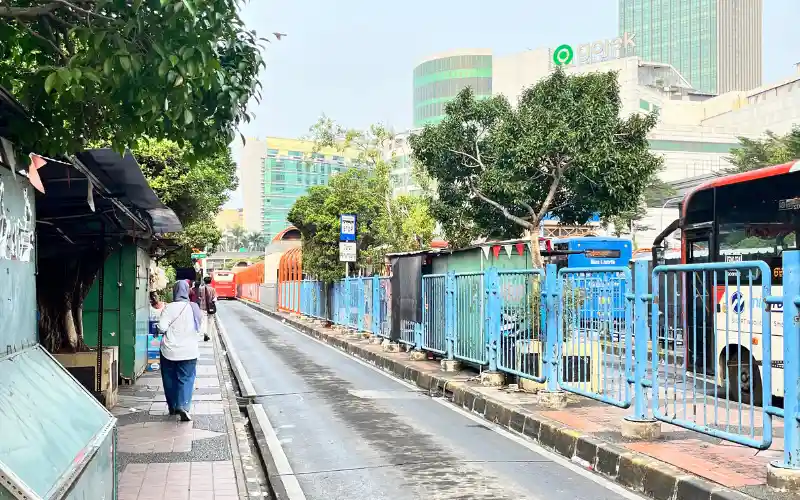
AFTER three years of living safely in Jakarta, a thief finally succeeded in reminding me that her glorious streets are not always safe. In Menteng, a motorcycle-riding thief was able to snatch away the mobile phone I was using while walking towards another building.
There are several theories behind that walk:
First, it was better to walk a couple of buildings away going to my destination instead of taking the car.
Second, I was a moron.
I heard from my colleagues that this is a common practice in Jakarta. Not the walk, but the motorcycle-riding thieves who pry mobile phones away from unsuspecting pedestrians. Initially, I thought of running after the thief, but then I realized that there weren’t any nearby phone booths where I could rip open my suit, change into my outfit, and fly up, up and away. Nor was I donning a red leotard suit equipped with lightning-fast feet. No. I wasn’t wearing any of those.
Instead, I was a mere mortal that felt helpless looking at the thief as I ate his dust. I have mixed emotions until now, actually. Perhaps it’s what psychologists refer to as shock. Or maybe my subconscious is simply telling me that I had it coming.
Thieves. I would’ve wanted to be angry, to get back at him, to report it to cops whom I’m certain could do nothing as they interviewed me, a useless witness.
“What was he wearing?” the cop would probably ask.
“Penguin suit? I don’t know.”
“Did you get to read the plate number of the motorcycle?”
“Yeah, satu, tiga, um, ah, how do you say eight in Bahasa Indonesia?”
Case dismissed. Another idiot in the long lines of idiots they’ve had so far. But is there a way by which ordinary pedestrians like me can seek grievance from all these?

Technologically speaking, the IMEI of mobile phones could be a lifesaver. Cops could zero in on its location by keying in the IMEI and render the phone useless; or trace wherever the thief gets to fence the merchandise by advising distributors of my phone’s IMEI, or triangulate via GPS and catch the thief. You could not only arrest my particular thief, but you can actually negate the viability of mobile phone thievery by making it financially useless for them to do so.
Should I talk to the cops? Or should I consider it as payback for my own notorious thievery in the past. Oh, the many hearts I’ve stolen from the numerous phones I’ve used; the many business deals I’ve stolen from competitors; the many infamous ways by which I’ve stolen opportunities from others, I suppose.
I can’t recall any specific detail, but I’m sure from another person’s point of view I may have been a thief in one way or another. The only difference is that I’m wearing an Ermenegildo Zegna suit, driven in a company car, and command my nefarious plans in a boardroom while my colleague, if you may, covers the streets of Jakarta.
We’re all thieves, in one way or another, I suppose. Just look at National Geographic’s daily shows and it’s an endless stream of lions stealing young gazelles, hawks swooping down to snatch another animal’s young, or hyenas racing fast to go for the kill.
In Darfur, governments steal decent lives from citizens. In war zones, the thievery does not stop with goods—it begins with people’s lives. In many countries, corruption steals opportunities, trust, and prosperity from ordinary people.
When will it stop? When citizens complain? Or when we do?
A thief once burglarized a Zen monk meditating in the privacy of his home. The Zen monk stopped and looked at him and told the thief where he kept his valuables, then continued meditating. The thief left but was later apprehended by the police. The police asked the Zen monk if the person was the thief and the monk said:
“No, I showed him where they are. I gave it to him. Had he stayed, I could have given him this bright full moon!”
The thief at once had an awakening and decided to become a Zen student.
I may not be a Zen monk or student, but I’ll be walking the streets of Jakarta with the same nonchalance and confidence I always had. The thief may have succeeded in stealing my phone—he deserved that—but he did not succeed in stealing my faith in people.
Perhaps we could all do our share and stop ourselves from our own thieving ways … the small acts that steal the very smile from others. And perhaps, just perhaps, I could wear that red suit under my shirt.
© N. Mark Castro