

Editor’s Note:
This opinion column by Aida Greenbury was originally written following an environmental pollution incident in Indonesia during 2003–2004. While the specific events described belong to that period, the broader message about civic responsibility, environmental awareness, and the importance of public engagement remains relevant today. The views expressed are those of the author and are published to encourage discussion rather than represent the editorial position of Living in Indonesia.
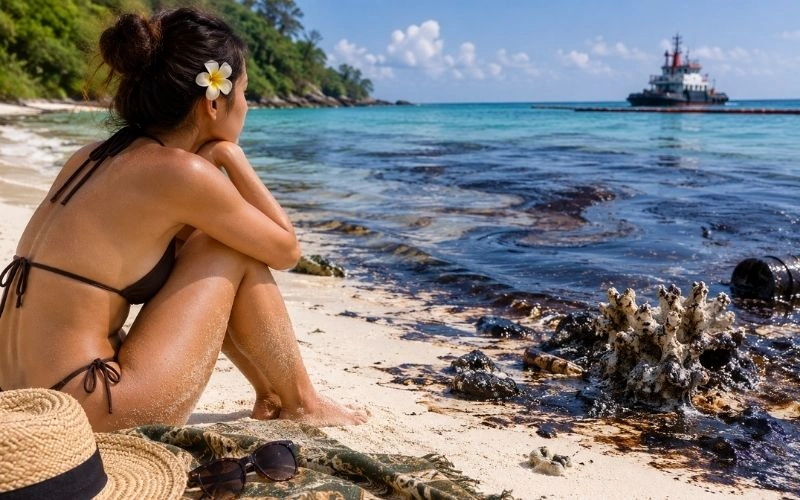
I am a beach person. You know how some people are categorised according to what they feel passionate about, whether they are classified as a dog person or a cat person, a beach person or a mountain person. I’m guilty of being one who loves doing nothing else but lazing around half naked on a warm white sandy beach under the hot sun, with gallons of coconut oil smeared on my skin, sufficient oil in fact to cook an egg sunny side up. A perfect glistening beached whale.
After months of hard work in a high-pressure city like Jakarta, nothing is better than escaping for a few relaxing days to an unspoiled beach on Lombok, the Great Barrier Reef or simply the furthest island in the Thousand Islands. Because, believe it or not, despite their close proximity to the heavily polluted city of Jakarta, most of the islands within the Thousand Islands are not inhabited by mutant creatures.
The Java Sea currents somehow manage to block the black traces of Jakarta’s waste from reaching the furthest islands. This phenomenon can easily be witnessed from inside a plane just before landing at Soekarno-Hatta Airport—the murky waste flowing out from Jakarta’s waterways gradually mixes with the bluish seawater. Then, just like a maestro’s painting, the visible pollutants seem to fade and blend away while slowly being absorbed by the unknown deep. What am I doing? Why am I trying to describe Jakarta’s rubbish to make it sound so bloody romantic?
Knowing that the beach has always been such a happy part of my life, I was shocked when I read a newspaper headline in early 2004. It reported that Pabelokan Island, one of the beautiful Thousand Islands, had been heavily polluted with floating crude oil. The fishermen lost their livelihoods, the coral reefs were smothered, fish either died or swam away, and nearby resort islands were threatened by the spreading pollution.
At the time, it was still unclear who was responsible—nearby offshore oil operations or passing oil tankers. Environmental organisations and government agencies were investigating the source.
A few weeks later, while speaking with the chairman of Friends of the Earth, a local environmental NGO, I was surprised to learn that the pollution had actually been discovered and reported months earlier, in September 2003. Why had most people only heard about it in February 2004? Why did so few people seem aware of what had happened? I smelled something fishy.
When I asked the chairman why most Jakartans hadn’t reacted more strongly, he simply shrugged and said one word—apathy.
He told me he had grown accustomed to public indifference. According to him, international environmental organisations often seemed more vocal than many local citizens. From what I gathered, too many people simply did not care unless they were personally affected. As long as their own homes remained safe and food still appeared on the dinner table, someone else’s problem remained someone else’s problem.
Yes, there would be demonstrations. Protesters would gather in the city’s busiest streets during lunch hour, demanding action. But by evening, life would return to normal, and before long the issue would quietly disappear from public attention—until the next crisis arrived.

A good example was Jakarta’s annual flooding. Every year people protested.
“Why? How? Who’s to blame? Sue the governor! We can’t keep living like this! Traffic jams for five hours! My BMW is ruined because of the flood! My new shoes are soaking wet!”
Then, a few days later, life carried on as usual until the following rainy season, when exactly the same complaints would be heard all over again.
Do Jakartans simply accept these disasters as an unavoidable part of life? Do they realise that some of these problems are made worse by our own actions—or inaction? Is it possible that the same people who proudly speak of gotong royong and musyawarah untuk mufakat sometimes struggle to apply those values when dealing with environmental issues that don’t immediately affect them?
How can we encourage people to understand that pollution in the Thousand Islands was not just someone else’s problem? That flooding, pollution and traffic congestion are challenges that require all of us to take responsibility?
Perhaps it starts with simple actions: not throwing rubbish into rivers, leaving green space around our homes instead of paving every available surface, avoiding behaviours that worsen traffic congestion, and thinking more carefully about how development affects the environment.
I believe it’s time we stop turning a blind eye before the problems become too large to ignore. Problems do not disappear simply because we choose not to look at them. They quietly grow until they become far more difficult to solve.
So perhaps, for a while at least, we should spend a little less time smiling politely and a little more time rolling up our sleeves to help fix the problems around us. Let’s show the world that Indonesians care deeply about protecting the country they love.
…But first, I’ll spend a couple of relaxing days at my favourite beach.
by Aida Greenbury
First published in the Jakarta Post.