Editor’s Note:
This article is intended as humor and satire. While it playfully exaggerates some aspects of driving culture in Indonesia, road conditions, vehicle safety standards, driver licensing requirements, and traffic enforcement have improved significantly over the years. That said, anyone who has spent time on Indonesia’s roads will likely recognize a few familiar situations!
To operate a motor vehicle in Indonesia, you must understand the transportation gestalt in an entirely different way. Definitions that you thought were above redefinition will immediately be redefined. Please pay attention.
The Road
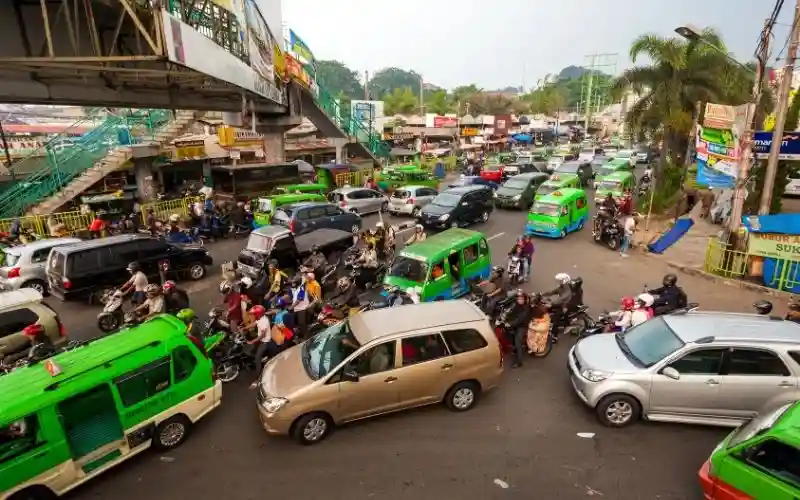
Includes not only the paved portion of the highway, but also what others might call the verge, the curb, the sidewalk, the front yard and the roadside restaurant. The paved portion of the roadway is generally one lane wide. Not one lane in each direction, but one lane.
Respect
All animals are granted the greatest respect in Indonesia. It is presumed that, being highly evolved creatures, chickens and dogs and the like know how to sidestep a Mitsubishi going 78 mph on a fog-shrouded road during a national religious holiday.
This same position of honor is granted to small children, men with 30 pounds of hay on their heads, unattended oxcarts and elderly women in mystic trances. Slowing or swerving to avoid these beings would cause them dishonor.
Lanes
These colorful white and yellow markings wish a hearty Selamat Datang (welcome) to every traveler. They have no other function.
Passing
The national sport of Indonesia. Observant motorists may encounter the vertical triple (passing three vehicles in one acceleratory movement), the horizontal triple (passing a vehicle that itself is in the process of passing a vehicle), or even the rare double-double (passing a vehicle at precisely the same time that another vehicle, coming in the other direction is also engaged in the act of passing).
Tailgating
What to do when not passing.

Being Passed
An insult not to be endured. The greater the differential between your vehicle (say, a Boeing 747), the greater the potential loss of prestige. The owner of the less powerful vehicle must always do everything in his/her power to thwart the attempt to overtake.
Seat Belts
Absolutely unnecessary. Not only are they not worn, they are not even provided. Passengers are fully protected by the horn.
Lights
Rapidly blinking the headlights can mean many things, including “OK to pass now,” “dangerous to pass now,” “get out of the way,” or “may you find the thread of gold in the linen of existence.” It takes years, sometimes entire lifetimes, to learn this subtle and intriguing intuitive nonverbal communication skill. Generally, however, you have about three seconds.
The Horn
When sounded loudly and frequently, the horn sets up an invisible energy barrier protecting the vehicle and its inhabitants from all harm. The faster the vehicle is going, the better the horn works. This is the central concept of Indonesian motoring.
Accidents
Rare. Usually the result of a malfunctioning horn.
Adapted from an article by Jon Carroll, San Francisco Chronicle, November 4, 1988.
(And, according to many long-term residents, not quite as much has changed as one might expect!)
© Held by the author.