

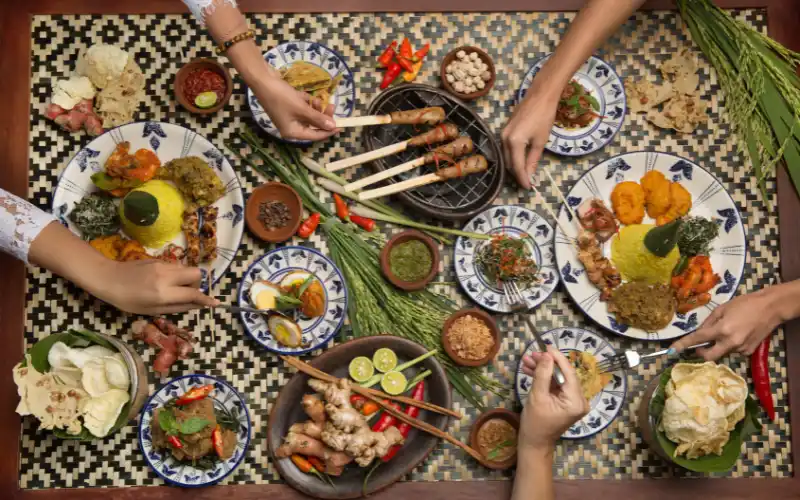
Have you ever tasted Indonesian food? Some expatriates never go beyond the usual nasi goreng (fried rice), bakmi goreng (fried noodles), or sate (charbroiled meat or chicken on skewers), but for the more adventurous there is a wonderful variety of tasty treats to discover throughout Indonesia.
Indonesia is the world’s largest archipelago, stretching across more than 17,000 islands. Its cuisine reflects centuries of trade, migration, and cultural exchange, blending indigenous traditions with Chinese, Indian, Middle Eastern, and European influences. The result is one of Southeast Asia’s most diverse and flavorful culinary traditions.
Food Etiquette
Indonesians love to eat, not only meals, which they may consume at any hour of the day whenever they feel hungry, but also snacks of many kinds. Eating is a social activity and meals are often shared with family, friends, neighbors, or unexpected guests. Hospitality remains an important part of Indonesian culture, and visitors are almost always offered drinks and snacks when they arrive.
Normal Mealtimes
A traditional Indonesian family meal usually consists of white rice accompanied by several dishes of meat, fish, vegetables, sambal, and condiments. Meals are generally served family-style, with all dishes placed on the table at once for everyone to share. Guests are encouraged to sample a variety of dishes and often invited to take second helpings.
Unlike formal Western dining, courses are rarely served separately. Soup may accompany the meal or be enjoyed afterward, depending on regional customs and personal preference.
Eating on the Floor and With Your Fingers
In some parts of Indonesia, particularly in Java, meals may be eaten while seated on mats in a style known as lesehan. Traditionally, food is eaten with the fingers of the right hand, while the left hand is reserved for non-eating tasks. Finger bowls may be provided after the meal.
Today, most Indonesians use a spoon and fork. The spoon is the primary eating utensil, while the fork is used to assist in gathering food onto the spoon.
The Importance of Rice in an Indonesian Meal
Rice remains the cornerstone of Indonesian cuisine. Many Indonesians still joke that “if you haven’t eaten rice, you haven’t really eaten.” White rice is served with most meals, though brown rice and other grains are becoming more common among health-conscious consumers.
Popular rice-based dishes include:
- Nasi goreng (fried rice)
- Bubur (rice porridge)
- Nasi uduk (coconut rice)
- Nasi kuning (turmeric rice)
- Nasi kebuli (Middle Eastern-inspired spiced rice)
- Nasi rames (rice served with assorted side dishes)
Rice also appears in special ceremonial dishes such as tumpeng, a cone-shaped mound of yellow rice traditionally served during celebrations and important milestones.
Selamatan and Special Rice Dishes
For celebrations and ritual meals known as selamatan, Indonesians often serve nasi kuning in the form of a beautifully decorated tumpeng. Other traditional rice preparations include lontong, ketupat, lemang, and nasi timbel, each associated with different regions and cultural traditions throughout the archipelago.
Regional Food Specialties
One of the joys of exploring Indonesian cuisine is discovering how dramatically food varies from one region to another.
West Sumatra (Padang Cuisine)
Padang cuisine is famous for its rich use of chili, spices, and coconut milk. Signature dishes include:
- Rendang
- Gulai
- Kari
- Kalio
- Dendeng balado
Rendang, in particular, has earned international recognition and is frequently cited as one of the world’s most beloved dishes.
Central and East Java
Javanese cuisine is generally sweeter than food from other regions. Palm sugar and sweet soy sauce feature prominently in many dishes.

Popular specialties include:
- Gudeg
- Opor ayam
- Ayam goreng
- Empal daging
- Semur daging
- Sayur asem
- Rawon (East Java)
West Java (Sundanese Cuisine)
Sundanese food emphasizes freshness and simplicity, often featuring:
- Lalab (fresh vegetables)
- Sambal
- Pepes ikan
- Nasi timbel
- Sayur lodeh
- Sayur asem
Meals are frequently accompanied by raw vegetables and a variety of sambal preparations.
Bali
Because Bali’s population is predominantly Hindu, pork plays a much larger role in Balinese cuisine than elsewhere in Indonesia.
Popular Balinese dishes include:
- Babi guling
- Lawar
- Bebek betutu
- Sate lilit
- Ayam bumbu Bali
North Sulawesi (Manado)
Manado cuisine is known for its bold flavors and generous use of chili.
Popular dishes include:
- Ayam rica-rica
- Ikan kuah asam
- Cakalang rica
- Woku dishes
- Sayur Manado
Beyond the Major Culinary Regions
While Padang, Javanese, Sundanese, Balinese, and Manado cuisines are the most widely known internationally, Indonesia’s culinary diversity extends much further. Kalimantan is known for river fish dishes and Soto Banjar, Maluku for seafood and papeda, and Papua for sago-based dishes that reflect a very different food tradition from rice-dominated Java and Sumatra.
Tempeh: Indonesia’s Gift to the World
No discussion of Indonesian food would be complete without mentioning tempeh. Originating in Java, tempeh is made from fermented soybeans and has become popular worldwide as a nutritious plant-based protein. While often associated with vegetarian diets abroad, Indonesians have enjoyed tempeh as an everyday food for generations.
Modern Indonesian Dining
Indonesia’s food culture continues to evolve. Today, traditional street food vendors operate alongside modern cafés, international restaurants, and food halls. Food delivery services through apps such as Gojek and Grab have transformed the way many Indonesians order meals, making regional specialties available with just a few taps on a smartphone.
At the same time, traditional markets, warungs, and family-run restaurants remain at the heart of Indonesian culinary life, preserving recipes and cooking methods passed down through generations.
Enjoy the Adventure
Whether you start with nasi goreng and sate or dive straight into rendang, gudeg, papeda, or bebek betutu, Indonesian cuisine offers an extraordinary culinary journey through one of the world’s most culturally diverse nations.
As Indonesians say:
Selamat makan! (Enjoy your meal!)