

Editor’s Note
This article was originally written for expat.or.id and has been updated in April 2026 to reflect current PLN standards, billing systems, mobile app usage, and household electricity classifications.
Electricity in Indonesia is supplied by the state-owned company, Perusahaan Listrik Negara (PLN). For most expatriates living in Indonesia, electricity supply is generally reliable in major cities, though there are still differences in infrastructure, billing systems, and household capacity compared to what many are accustomed to in Western countries.
Understanding how electricity works is an important part of settling into daily life. You may also find it helpful to read related practical information in https://expat.or.id/info/settlingin.html and https://expat.or.id/info/housing.html, as electricity usage is closely tied to housing conditions in Indonesia.
Electrical Standards and Plug Types in Indonesia
Indonesia operates on a 230 volt, 50 Hz electrical system. In earlier years, this was often referred to as 220 volts, and you may still see this in older references, but the current standard is aligned closer to 230 volts. The most commonly used plugs are Type C and Type F, which are compatible with most European-style appliances.
Many modern electronic devices such as laptops and phone chargers will function without issue. However, appliances from countries using 110 volts will require a transformer. When relocating, it is advisable to review your household equipment in advance as outlined in https://expat.or.id/info/shippinghouseholdgoods.html.
Understanding Household Electricity Capacity (Daya Listrik)
One of the most important differences that expatriates will notice is that electricity supply to homes is limited by a fixed capacity. Unlike in many Western countries where supply is effectively unlimited for normal household use, homes in Indonesia are assigned a maximum load, measured in Volt-Ampere (VA). This capacity determines how many electrical appliances can be used at the same time.
Household electricity categories are defined by PLN and generally fall into several ranges. Non-subsidized residential users are typically within the R-1 category (1,300–2,200 VA), R-2 (3,500–5,500 VA), or R-3 (6,600 VA and above). Most expatriate housing falls within these non-subsidized categories.
It is not uncommon, however, to find that even larger homes have relatively limited electrical capacity. This is often a deliberate decision by property owners. Electricity tariffs increase with higher capacity levels, and many landlords choose to keep the installed capacity lower in order to avoid higher fixed charges. As a result, tenants may experience power outages within the home (a tripped breaker) if multiple high-consumption appliances such as air conditioners, ovens, or water heaters are used at the same time.
Electricity Billing in Indonesia: Postpaid vs Prepaid
Electricity billing in Indonesia is available through two main systems: postpaid (pascabayar) and prepaid (prabayar).
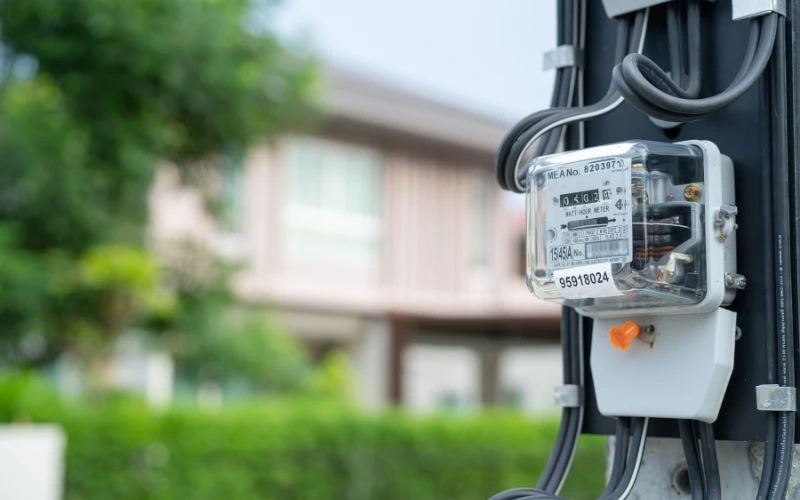
In a postpaid system, electricity usage is recorded and billed monthly. In a prepaid system, electricity must be purchased in advance in the form of a token. This token is entered into the meter using a 20-digit code, and the available credit decreases as electricity is consumed. The meter itself is identified by an 11-digit number.
In the past, there was a perception that prepaid electricity was required for new connections. This is no longer the case. Customers applying for a new connection can generally choose between prepaid and postpaid systems, depending on their preference and the property setup.
While prepaid electricity is widely used across Indonesia, most expatriate rental homes continue to operate on a postpaid basis. If you are unsure which system applies to your residence, it is advisable to confirm this during your housing search, particularly when reviewing options in https://expat.or.id/info/housing.html.
How to Pay Electricity Bills in Indonesia
Paying electricity bills has become significantly easier in recent years. The primary method is now through the PLN Mobile application, which allows users to check their bill, make payments, purchase prepaid tokens, report outages, and request service changes.

In addition to the PLN Mobile app, payments can also be made through online banking platforms, ATMs, and various e-wallet services. Many banks now allow customers to pay electricity bills or purchase tokens directly through their mobile banking applications, eliminating the need to visit a bank in person.
This shift toward digital payment methods reflects broader changes in Indonesia, where many daily transactions are now handled electronically. You may also notice similar systems in use for toll roads, parking, and retail payments.
Electricity Tariffs and Costs
Electricity tariffs in Indonesia are regulated by the government and are subject to periodic review. For non-subsidized customers, which includes most expatriates, tariffs are relatively stable but may be adjusted in line with government policy.
The cost of electricity is influenced by the household’s installed capacity (VA level), and higher capacity homes will generally have higher tariff structures. This is one of the reasons why some landlords limit the electrical capacity in their properties.
It is advisable to check current rates through official PLN channels or the PLN Mobile app, as pricing structures can change over time.
Power Outages and Reliability
While electricity supply in major urban areas is generally stable, power outages can still occur. These are typically caused by weather conditions, maintenance work, or localized distribution issues rather than systemic shortages.
In the event of a power outage, customers can check the status through the PLN Mobile app or contact PLN via the national call center at 123 (or by dialing the local area code followed by 123).
For broader safety and emergency planning, you may also wish to review https://expat.or.id/info/emergency.html.
Increasing Electricity Capacity
If a household experiences frequent power trips due to insufficient capacity, it is possible to request an increase in electrical capacity through PLN. This can be done through the PLN Mobile app or at a local PLN office, although approval will depend on the infrastructure available in the area and will involve an additional cost.
Before signing a lease, it is advisable to discuss electricity capacity with your landlord and confirm whether upgrades are possible if needed.
Daily Electricity Usage in Indonesia
From a practical standpoint, managing electricity usage becomes part of daily life in Indonesia. Air conditioning units, water heaters, and kitchen appliances can quickly exceed the available capacity if used simultaneously.
It is therefore common practice to be mindful of which appliances are in use at any given time. This adjustment in behavior is one of the key differences expatriates experience, as electricity supply is not simply about cost, but also about managing available load.
Expat Tip
In many Indonesian households, there are often additional people present in the home, such as domestic staff or drivers. It is important to ensure that anyone managing the household understands the limitations of the electrical capacity and how to avoid overloading the system.
Simple practices such as not running multiple high-consumption appliances at the same time can prevent unnecessary disruptions.