

Editor’s Note:
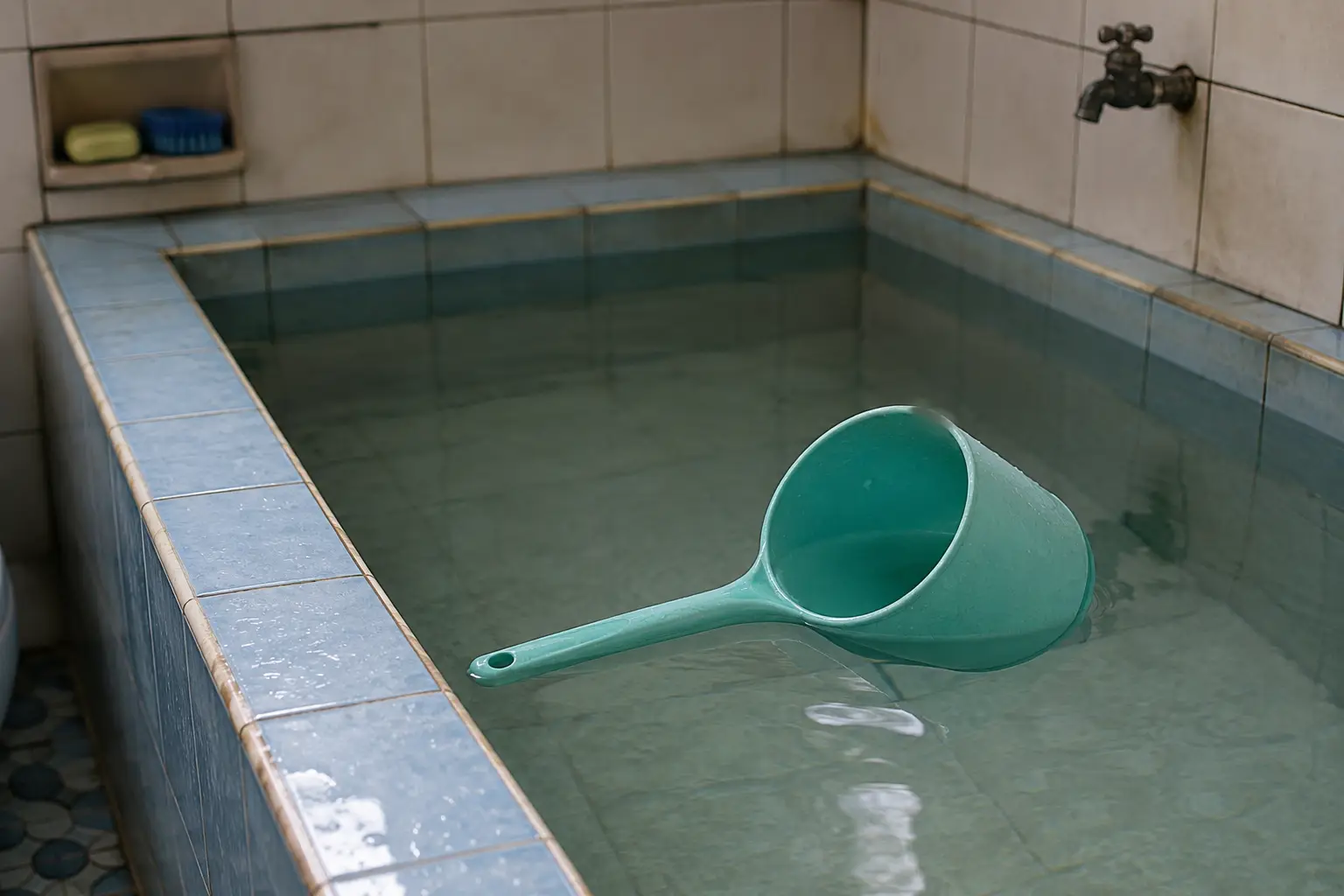
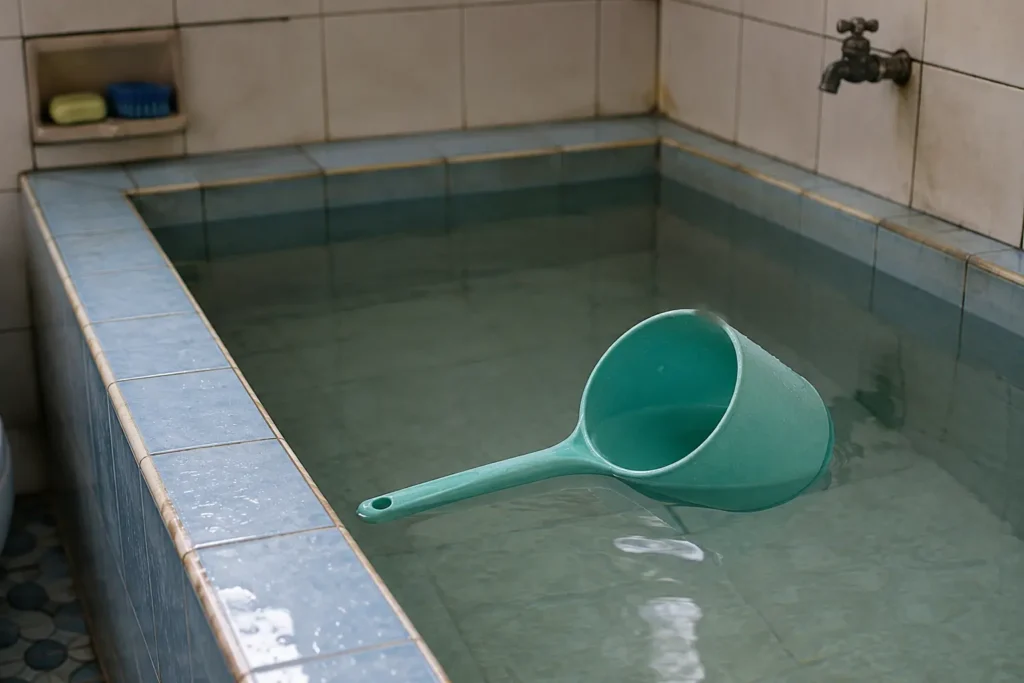
For readers unfamiliar with traditional Indonesian bathrooms, many homes and guesthouses once featured a bak mandi—a large water storage container used for bathing and flushing toilets. Water is scooped from the bak mandi using a plastic dipper called a gayung.
In the early days of the Living in Indonesia website, expatriates and Indonesians frequently exchanged observations and opinions through the site’s Expat Forum. One light-hearted discussion asked a surprisingly passionate question: Is it impolite to leave the gayung floating in the water of the bak mandi?
The responses below are preserved as a snapshot of opinions shared by forum members in 2001. They do not represent an official Indonesian custom, but rather the personal experiences, habits, and humour of the contributors.
Here They Are, the Exciting Web Poll Results!
The question was:
“Is it impolite to leave the gayung floating in the water of the bak mandi?”
Responses:
Yes = 4
No = 1 (but he changed his mind under cross-examination)
Neutral = 1 (but admits the correct thing to do is to take it out of the water)
Irrelevant Tangent = 1 (well, two if you count beck’s response)
I think it’s clear. The answer is YES, it’s rude to leave the gayung floating in the water. Now get out there and spread the gospel to the unwashed heathen masses (well, I guess they must be washed, but that’s beside the point).
A Synopsis of the Results
Anak Laut: Neutral. Correct is upside down on the side of the bak mandi, but maybe Indonesians don’t care. This may be some people’s pet peeve.
[Very insightful of you AL.]
Joko: No. Leave it any which way, no one cares.
(But under cross-examination he acknowledged that it annoyed his mother when it was left floating in the water.)
[Extra credit for honesty, Joko.]
PJ: Yes. PUT IT BACK ON THE MANDI.
[Clearly a pet peeve, yes?]
Marina: Yes. Put it back on the mandi or it gets slimy, and slime is never polite.
Dani: Yes. Put it right side up on the edge of the bak mandi. She then reminded us of the old coconut shell dippers.
[Yes, I still see those sometimes in my travels.]
Stone Age: Irrelevant tangent. Doesn’t matter because only backwards people in backwards places use the traditional bathroom.
Joko and Stone Age then mixed it up for a bit and digressed into discussions of Jerry Yang.
Finally, My Response
As if you couldn’t guess.
Me: YES, PUT IT BACK ON THE SIDE YOU PIGS. WHAT IF I HAVE DIRTY OR SOAPY HANDS, HUH? HOW THE HELL WILL I GET THE GAYUNG OUT WITHOUT GETTING THE WATER GROSS? SPEAKING OF WHICH, HOW THE HELL DO YOU DO IT? YOU MUST BE THE ONE GETTING THE WATER ALL CLOUDY AND GROSS AREN’T YOU?!!!!! ADMIT IT!!!
The Complete Responses
Posted by Anak Laut on March 25, 2001
“is it impolite to leave the gayung floating in the mandi water?”
You mean floating in the kamar mandi? Of course it’s impolite because it means you’ve flooded the bathroom.
But if you mean floating in the water container (the bak mandi), the right thing to do is leave the gayung upside down on the side.
I don’t think Indonesians really care about how you put the gayung, but it could be someone’s pet peeve.
Posted by Joko on March 25, 2001
You mean “Bak Mandi”?
Answer is nobody pays attention to details such as that, but…

My mom prefers to keep it neatly on top of the bak mandi.
Posted by PJ on March 25, 2001
I hate it when it’s in the water!
Without a doubt, my answer is an emphatic:
“Put it on the bak mandi!”
I just asked my Indonesian husband and he said:
“Kalau di atas air tidak sopan.”
(Different answer from Mas Joko though…)
Posted by Joko on March 26, 2001
I guess you’re right.
No wonder my mom always yelled at me.
Posted by Stone Age on March 28, 2001
Do you live in the Stone Age or something? Unless you live in a far away and poor village, no one uses that mandi anymore.
Posted by Joko on March 28, 2001
Absolutely, unless you don’t live in Jakarta.
And the poll reads: if it is not pertaining to you, do not answer!
Just curious, do you live in a high-tech house? Silicon Valley resident?
If so, check it out—even Jerry Yang takes out the trash himself every Monday evening!
Posted by Stone Age on March 28, 2001
What’s Jerry Yang got to do with dippers?
FYI, met Jerry Yang and his lieutenants two years ago. We ended up putting more venture money in one of his acquisition targets.
Any more questions about Jerry Yang, backward boy?
Posted by Marina on March 26, 2001
Yes, it goes slimy and slime is never polite.
Posted by Dani on March 26, 2001
Remember batok kelapa dippers?
Remember when the dipper (gayung) was made from a coconut shell and not plastic? It wasn’t so long ago.
Now think of that coconut-shell dipper floating around in the water day after day and you can easily see why people were told to keep the dipper out of the water after use.
In my husband’s family, his mother (a great matriarchal type) insisted the kids bring the batok kelapa outside the bathroom after use and hang it up so it could dry out between uses.
Very different world with all the plastic now.
BTW, in our house we keep the dipper on the ledge of the bak mandi and turned open side up. If you turn it upside down, yucky mold could grow inside too.
Wow… interesting stuff in this thread.
What’s next?
This web poll was solicited and compiled by MS, a regular contributor to the Living in Indonesia Expat Forum.
Editor’s Note
Today, many Indonesian homes use showers and modern plumbing systems, particularly in urban areas. However, bak mandi and gayung are still commonly found in many homes, boarding houses, rural areas, traditional accommodations, and even some modern bathrooms as a backup water source.
As this forum discussion humorously demonstrates, there was never complete agreement on the “correct” place to leave the gayung. Nevertheless, many Indonesians do prefer that it be placed neatly on the edge of the bak mandi after use, both for cleanliness and appearance.
This is the kind of nostalgic forum content that works best as a “slice of expat life in Indonesia” rather than an instructional article. The editor’s notes provide enough context for modern readers while preserving the humour and personality of the original discussion.