

Editor’s Note:
This article was written as a humorous social commentary reflecting Indonesia during the period in which it was originally published. Many of the situations described were based on real experiences at that time, when access to technology varied dramatically between urban and rural communities, and domestic staff often came from villages with limited exposure to modern conveniences. Indonesia has changed enormously since then. Today, smartphones, digital payments, GPS, and internet access are commonplace across much of the country. However, disparities in digital literacy, education, and access to technology still exist, particularly between generations, socioeconomic groups, and remote regions. Likewise, reliance on household staff for everyday tasks remains part of life for some affluent families, although it is generally far less pronounced than depicted here. The article should therefore be read as a light-hearted snapshot of a particular era rather than an accurate description of modern Indonesia.
Surrounded by today’s high-tech world, my kids are spoiled to their toes. They press the speed dial on the mobile phone to tell their daddy—who’s in the middle of a very important meeting—to pick up a bag of M&Ms on the way home. They press the conveniently located button in their bedroom to summon their nanny or the household staff. They turn on the computer to get online with their favourite Disney characters.
The annoying thing is that, being accustomed to all these technological conveniences, they rarely walk or use much energy anymore. Get in the car, get out of the car, get in the plane, get out of the plane, elevator, escalator—you name it. Their longest walk is probably from their bedroom to the kitchen, though they certainly don’t cook there. Instead, the familiar cry is, “Nanny! Two sunny-side-up eggs with melted cheddar, please!” Or they simply heat up a ready-made meal in the microwave.
Sometimes I wonder whether I’m partly to blame for filling our home with so many labour-saving devices.
Walking is important. It’s healthy, I repeatedly remind them. I often tell them about the time I completed my university fieldwork in a remote village in Java. Reaching the nearest water source for a bath required a twenty-minute walk. To my children, this sounds like something from another planet.
“Didn’t the sun burn your skin? Weren’t you exhausted?” they ask with genuine disbelief.
Unlike today’s traffic-filled Jakarta, there wasn’t a single car in that village. A simple short-wave radio was the most advanced piece of technology anyone owned.
Today, it’s remarkably easy to become dependent on technology. Many of us feel uncomfortable if we misplace our phone or lose our internet connection for a few hours. The convenience quickly becomes something we assume will always be available.
But that raises an interesting question: how quickly do different parts of society adapt when technology advances faster than education or experience?
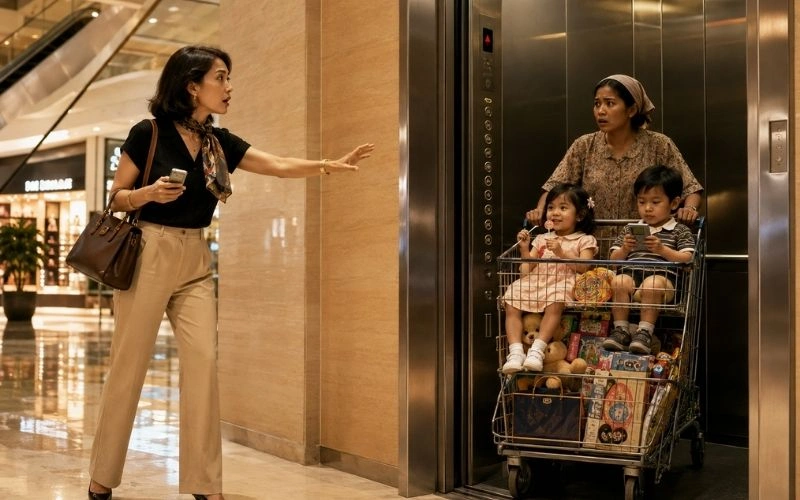
I once went shopping at Ratu Plaza with both children, each comfortably seated in a stroller pushed by the nanny and me. The nanny had only recently arrived from a small village in Java.
We waited for the elevator. The doors opened, she pushed the stroller inside, and the doors promptly closed—leaving me standing outside.
Only then did I realise that it had never occurred to me she might never have used an elevator before.
Fortunately, another shopper entered on the next floor and helped her return to the basement. My son, convinced he had permanently lost his mother, was in tears. The nanny looked equally terrified.

I remember another incident years earlier while staying in a hotel. Late one evening I noticed a young village girl standing motionless inside the glass elevator. People entered, pressed buttons, got out, and she remained exactly where she was.
Eventually I stepped inside and asked, “What are you waiting for?”
“I’m waiting for this thing to take me to the sixth floor,” she replied confidently.
It turned out she genuinely believed the elevator somehow knew where she wanted to go without anyone pressing a button.
Stories like these made me realise how dramatically people’s experiences could differ within the same country. At the time, someone arriving from a remote village might never have encountered elevators, escalators, computers, or automated ticket machines.
Indonesia has always contained remarkable contrasts. In one part of society, people eagerly embrace every new gadget. In another, someone may encounter that same technology for the very first time.
Even today, while smartphones are nearly everywhere, digital literacy still varies considerably. Some people use sophisticated financial apps, online banking, AI tools, and satellite navigation every day. Others rely primarily on phone calls and messaging because those are the technologies they know and trust.
The same contrast can be seen in affluent households.
One good example is my father. He’s a university professor but has never had much interest in learning computers.
“Why should I learn?” he once said. “I have a secretary who can do that for me.”
His attitude wasn’t unusual among some professionals of his generation. It wasn’t that they couldn’t learn the technology—they simply didn’t see enough value in doing it themselves.
Perhaps that’s the real lesson.
Technology should make our lives easier, but it shouldn’t replace curiosity, independence, or a willingness to learn. Whether we’re introducing new technology to people using it for the first time or raising children surrounded by every modern convenience, the goal should be the same: to understand how the tools work, appreciate when they genuinely help us, and avoid becoming completely dependent on them.
Indonesia continues to bridge worlds that often seem decades apart. That contrast has become smaller over the years, but it remains one of the country’s most fascinating characteristics.