

Editor’s Note:
This article was written by Ida Greenbury and reflects her personal observations and opinions about living in Indonesia during a unique period when Eid al-Fitr (Idul Fitri) and Christmas were celebrated only days apart in December 2000. Some references to Indonesian politics, government regulations, and social conditions reflect the situation at that time. Today, Indonesia continues to be home to one of the world’s most religiously diverse societies, and while discussions about holiday regulations and public observance still occur from time to time, the overall message of mutual respect and religious tolerance remains as relevant as ever.
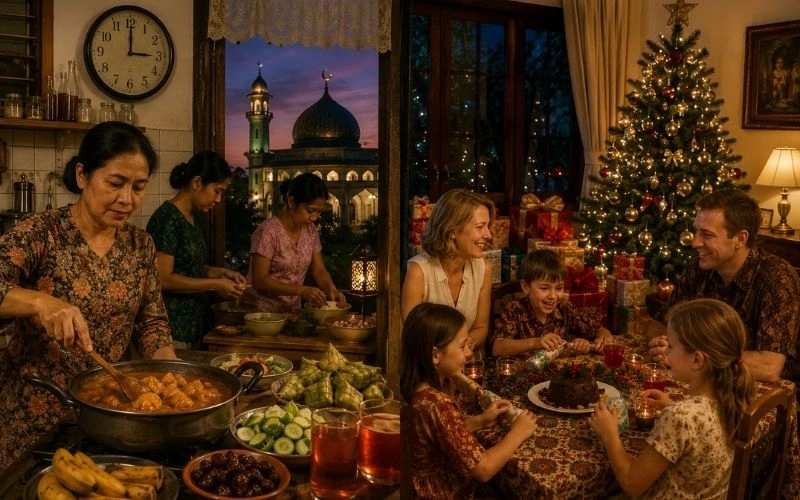
Anna looked up at the greasy clock on the kitchen wall. It was already three o’clock in the afternoon. It was a bit hard to see the numbers behind the grayish layers of smoke and fat covering the clock’s glass surface. She promised herself to get up there and clean it up when the fasting month was over. Right now, with what little energy remained, she was going to prepare dinner, also known as the breaking of the fast or buka puasa. When you are dehydrated and have had nothing in your stomach for the past nine hours, kitchen work can be tough, easily compared to construction workers who throughout this month carry bricks without their familiar cigarettes in their mouths.
Anna and her family are Indonesian Muslims. They had been fasting for almost a month—no drinking, no eating, carefully controlling their emotions, and abstaining from sexual relations from dawn until dusk are among the sacrifices observed during this special month. Ramadan was almost over. The following day, the family was going to witness the sighting of the crescent Shawwal moon, symbolising the end of the holy month. Then a new beginning starts. After thirty days of self-reflection and spiritual discipline, Muslims celebrate Idul Fitri (Eid al-Fitr), marking the end of Ramadan and a return to spiritual purity.
Anna opened the fridge. There was a whole chicken, a bunch of palm-leaf wrapped rice cakes and palm sugar-soaked bananas for dessert. The perfect sugar-fix meal for breaking the fast! Chicken curry, ketupat (rice cakes), and sweet desserts are typical dishes enjoyed during Idul Fitri celebrations. They aim to quickly restore energy after a day of fasting; although, as I couldn’t help noticing, they may also contribute rather generously to one’s annual cholesterol intake.
“Siti, Marni! Could you please help me prepare the food?” Anna shouted, calling her temporary housemaids. She had to pay twice the normal wages because her regular domestic staff had already left for their hometowns ahead of the mudik holiday exodus. One of the privileges of being both well-off and fasting is having someone else do the cooking when your energy is running low.
An hour later, she returned to the kitchen only to find that her supposedly experienced maids had turned the place into a messy shipwreck. Coconut milk splattered the walls. A troop of ants marched across the window sill, attracted by pieces of brown sugar scattered across the floor. Typical domestic chaos!
Anna took a deep breath.
“I’m fasting. I can’t give in to anger,” she whispered to herself.
She quietly cleaned the kitchen under the puzzled gaze of the maids, whose expressions seemed to say, What did we do wrong?
Anna felt relieved knowing the next day would mark the end of Ramadan. She would go with her family to the mosque early in the morning for Eid prayers before visiting relatives she only saw once a year, asking forgiveness and enjoying mountains of snacks and brightly coloured sweet drinks. She had been looking forward to it for weeks.
Imagine the same evening, just a hundred metres away from Anna’s house, a completely different celebration was taking place.
Julie, an Australian who had been living in Jakarta for six months, sat at one end of her dining table while her husband sat at the other. Between them, their four children eagerly searched through slices of plum pudding, hoping to find the traditional silver coin hidden inside. Their eyes repeatedly drifted towards the corner of the living room, where a pile of Christmas presents sat beneath a beautifully decorated artificial Christmas tree.
Julie smiled.
She reflected on how smoothly everything had gone. She had mailed her Christmas cards well in advance, knowing international mail from Jakarta often took longer to arrive. She had carefully avoided making the envelopes look too bulky to reduce the temptation of theft during transit. Christmas shopping had been surprisingly enjoyable. After visiting several Christmas bazaars around Jakarta, she joked that she had purchased enough decorations to last the next decade—including far too many glitter-covered Santa hats.
Although Christmas in Jakarta would never be white, it wasn’t entirely different from Christmas back home in Sydney. The Christmas morning service had been warm and welcoming, even if she only understood a small portion of the Indonesian-language sermon.
Anna and Julie are two women from different cultures and different faiths who happen to live in the same neighbourhood, each celebrating their own important religious holiday in their own way.

What made that particular December extraordinary was that Idul Fitri and Christmas were celebrated only two days apart in the year 2000.
If everything remained peaceful, free from unrest and political tension, it would become a truly unforgettable memory. You could even imagine shopping malls displaying Christmas trees decorated with woven green ketupat ornaments alongside the traditional decorations.
At the time, Indonesia was also experiencing significant political and social change following the end of the New Order era. Religious celebrations, government regulations and public expectations were evolving rapidly, and there were many public debates about how different faiths should be accommodated in public life.
I have always believed that genuine faith cannot be created simply through rules or restrictions.
Perhaps the more important question was never whether regulations would change, but whether people themselves would become more accepting of one another.
Before I wander too far into politics, I’ll stop myself.
I’ve always tried to keep politics separate from my writing.
But wouldn’t the world be a far better place if we had less politics, fewer wars, less racism and less fanaticism to argue about?
After all, that is the heart of every holy season—peace, compassion and tolerance.
Perhaps we could all be a little more like Anna or Julie.
Celebrate side by side.
Respect each other’s traditions.
Focus on what we share instead of what separates us.
“Minal Aidin wal Faizin, and Merry Christmas.”
Doesn’t that sound wonderful?
By Aida Greenbury
First published in the ICAC Magazine.