

Editor’s Note:
This article is a humorous personal essay written by Aida Greenbury, reflecting on her experiences and frustrations with traffic accidents in Indonesia in the early 2000s. While road conditions, insurance availability, policing, and public awareness have improved over the years, the article should be read as a personal opinion piece rather than a guide to how all traffic incidents in Indonesia are handled today. Readers should also note that traffic accidents can be unpredictable anywhere in the world, and the appropriate response is always to remain calm, ensure everyone’s safety, and follow local laws and insurance procedures.
The First Accident
One morning, a few years ago, I was driving my small red Suzuki up to Merapi Mountain. Merapi is a volcanic mountain located just north of Yogyakarta in Central Java. My father has a Shiitake mushroom farm at the foot of the mountain. Lucky me—I was working for him as low-paid labour with excessive hours, supposedly repaying the money he had spent raising me through my pampered childhood and adolescent life in Europe.
Listening to the car stereo and enjoying the fresh mountain air, I felt relaxed until I found myself trapped behind a motorcyclist riding painfully slowly on a narrow road. I honked several times, but he made no attempt to move aside.
So—with a devilish grin—I accelerated and bumped his motorcycle from behind.
I’m certainly not proud of what I did.
The rider quickly checked the damage to his motorcycle while local bystanders gathered around, ready to assume that the driver of the car was at fault. After giving him enough money to replace his broken tail light (which probably hadn’t worked anyway) and threatening to report him for deliberately obstructing traffic, I drove away.
The Second Accident
On another day, I was driving my brother’s car carefully in the correct lane at less than 30 km/h.
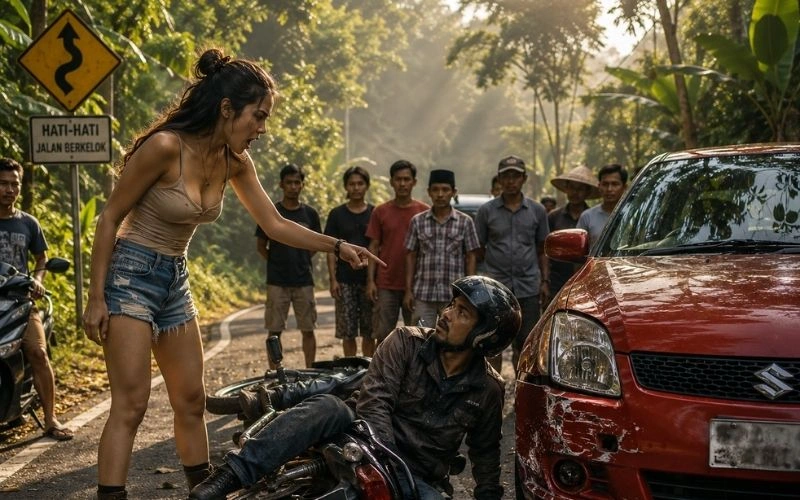
Suddenly, two motorcycles came toward me. One rider was so busy talking to his friend that he drove straight into my car and landed on the bonnet.
Within seconds, bystanders surrounded me, shouting:
“Stop! Don’t you dare run away!”
I was speechless.
I had been hit by the motorcycle, yet somehow I had instantly become the villain.
The Third Accident
My father once told me about a similar incident.
A motorcyclist crashed into his car, even though the accident clearly wasn’t my father’s fault.
Still, my father handed the rider some money.
His explanation was simple:
“I know it wasn’t my fault. But he was poor, his motorcycle was damaged, and I could afford to help.”
No wonder my father never became rich.
The Fourth Accident
My younger brother had recently bought his first car and proudly drove it from Jakarta to Yogyakarta during the Idul Fitri holiday.
As he carefully negotiated a sharp bend between Cilacap and Central Java, a couple on a motorcycle attempted to overtake him on the left, squeezing between the car and a rocky cliff.
There wasn’t enough room.
The motorcycle struck the car and the couple fell.

My brother immediately stopped, helped them up, took them to the nearest hospital, and paid their medical expenses.
Later, however, they demanded even more money.
My brother explained:
“I’m not wealthy. I only recently started working. I took you to the hospital and paid for your treatment, but the accident wasn’t actually my fault.”
Their response?
“You were driving the car, so obviously it was your fault. Besides, you have more money than we do.”
Eventually, exhausted by the argument, my brother simply handed over another Rp50,000 and left.
One More Story…
A few months later, a bajaj driver crashed into my parked car while speeding around a blind corner.
The damage was entirely his fault.
Although my car was insured, I wanted him to accept some responsibility.
Instead, he argued that because I owned a car and he was poor, I should pay for everything myself.
That was the moment I lost my temper.
I asked him:
“Who gave you the right to drive recklessly just because you’re poor? Do you think people with cars didn’t work for them? Do you believe only people with money should be responsible for the consequences of their own actions?”
Looking Back
These stories are really about one thing.
Well… perhaps two things.
First: make sure your vehicle has comprehensive insurance.
Second: people don’t always judge responsibility based solely on who caused an accident. Emotions, perceptions of wealth, and pressure from bystanders can sometimes influence how situations unfold.
Fortunately, insurance coverage, road safety awareness, legal procedures, and public understanding have all improved considerably since these stories took place. Even so, accidents remain stressful, and keeping calm while following the proper legal and insurance process is always the best approach.
And one final piece of advice.
If you’re a foreigner living in Indonesia, don’t imitate my behaviour in that first story. What might have ended with a heated argument for me could quickly escalate into a far more difficult situation for someone unfamiliar with the local language or circumstances.
By Aida Greenbury