

Editor’s Note:
This article reflects Aida Greenbury’s observations of Jakarta’s restaurant scene at the time it was written. While today’s dining landscape has evolved considerably—with thousands of excellent local and international restaurants across the city—one observation remains true: Indonesians love trying new places. Diners are often willing to queue for a new restaurant if the food receives good reviews, and they can become remarkably loyal customers when quality and service are consistently good. On the other hand, a disappointing first experience often means they simply move on to the next restaurant rather than giving a restaurant a second chance.
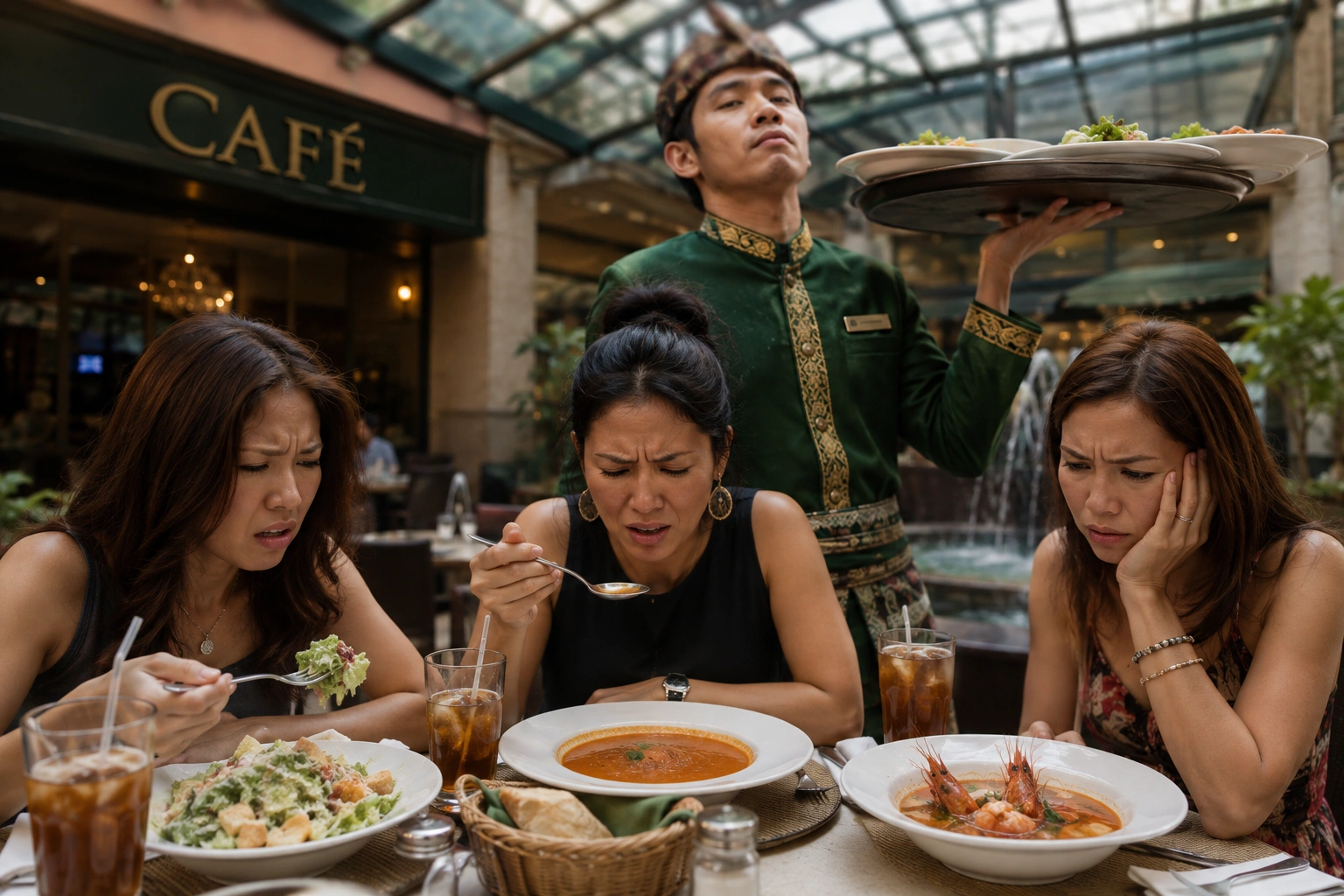
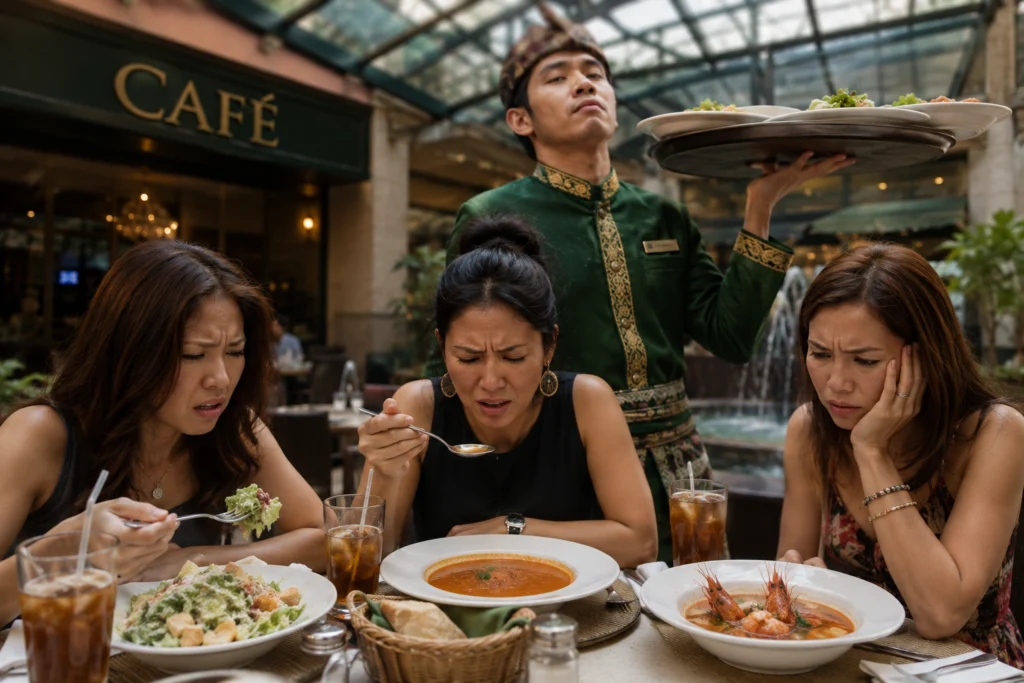
With his nose pointed upward and his right hand balancing a tray filled with perfectly arranged plates, the waiter elegantly approached our table. Without a mistake, he placed each dish in front of the correct guest.
“Bon appétit!” I said.
A few seconds later, I could barely swallow my first spoonful of minestrone. One of my friends choked on her Caesar salad, while the other stared in disbelief at three head-only prawns floating in her Tom Yum Goong.
My two friends and I were sitting in a newly opened upscale café in one of Jakarta’s exclusive shopping malls. We had been persuaded to try it by beautifully dressed staff in Balinese-inspired gold and green uniforms. Positioned strategically throughout the mall with menus and flyers, they were impossible to ignore.
The café itself featured an attractive Californian-inspired interior. Partially covered by a glass roof and accompanied by the soothing sound of a nearby fountain, it was certainly a pleasant place to sit—until the food arrived.
The waiter returned to ask whether he could clear our plates.
“I see you didn’t finish your meals, ladies. Was it too much?”
We had barely touched them.
“Well, the minestrone is far too thick—it tastes like tomato purée straight from the can. The Caesar salad smells very fishy. I suspect the anchovies aren’t fresh. And could you please ask the chef what happened to the rest of these three prawns?”
The waiter took several moments to process our comments before disappearing into the kitchen.
He returned shortly afterwards.
“The chef said this is exactly how Caesar salad and minestrone should taste. He also insists he put three whole prawns in the soup.”
Wonderful.
Not only were we apparently ignorant about food, but we were also being accused of stealing the missing prawn bodies.
The waiter walked away without offering even a simple apology.
The owner, elegantly dressed in black and entertaining guests at the VIP table in the corner, remained completely absorbed in showing off her new café. The unhappy experience of some of her very first customers appeared to be of little concern.
For many years, Jakarta has experienced waves of restaurant booms. Tourism, globalization, rising disposable incomes, changing lifestyles, and simply the desire to enjoy food prepared by someone other than the household cook have all contributed to the city’s thriving dining culture.
Typically, a newly opened restaurant is packed during its first year. Trendsetters, curious diners, celebrities, social media influencers (today’s equivalent of yesterday’s “fame-chasers”), and genuine food lovers all rush to try the latest hotspot.
Then, many quietly fade away.
Often, the problem isn’t the concept or the décor. It’s inconsistency.
The food changes from visit to visit. Service becomes unreliable. Standards begin to slip.

How many restaurant owners truly understand hospitality?
Perhaps fewer than we’d hope.
Some open restaurants because they genuinely love food and service. Others fall in love with the idea of owning a fashionable café after returning from overseas holidays. For some affluent entrepreneurs, a restaurant becomes more of a prestige project than a carefully managed business.
Unfortunately, staff training sometimes receives far less attention than interior design.
There always seem to be three priorities before a grand opening.
First comes the interior.
Depending on the owner’s imagination, the restaurant may feature beautiful—but highly impractical—design choices. Think Mexican-inspired architecture with floor-to-ceiling glass walls and an inadequate air-conditioning system. It looks wonderful until lunchtime.
Second come the staff uniforms.
They must be stylish, fashionable, and, preferably, as uncomfortable as possible.
Only then comes the menu.
Too often it resembles the one from the restaurant next door, which explains why entire neighbourhoods sometimes seem to serve identical nachos, pasta, and imported café favourites. Add a few French names, a frozen Quiche Lorraine, obligatory Spaghetti Bolognese, and voilà—the restaurant is ready for business.
The city’s most prestigious public relations company is hired.
A red carpet is rolled out.
Local celebrities arrive.
The owners proudly greet guests while the bewildered staff struggle to pronounce dishes they’ve never heard of before.
Have you ever ordered iced tea only to receive hot tea with a handful of melting ice cubes floating on top?
Or selected something described as “slightly spicy” only to discover your ears producing imaginary smoke after the first bite?
Or spent half an hour trying to catch the attention of a waiter while several staff members chatted amongst themselves or wandered aimlessly around the restaurant?
Experiences like these leave diners wondering why restaurant owners expect customers to pay premium prices while accepting disappointing food or indifferent service.
Beats me!
By Aida Greenbury
First published in The Jakarta Post.