

Ancient Chinese Porcelain Shards Reimagined as Jewelry in Indonesia
Across the centuries, traders traveled the world in search of rare and exotic treasures. Unlike merchants of centuries past, however, you don’t need to join a caravan or sail the high seas to discover these fascinating pieces of history. In Indonesia, fragments of ancient Chinese ceramics continue to inspire artisans who transform them into distinctive jewelry and decorative objects.
Today, jewelry made from antique ceramic shards remains a niche but enduring craft. While regulations governing archaeological finds have become much stricter, artisans still work with legally acquired antique ceramics, family heirlooms, salvaged fragments, and pieces that have long circulated through the antiques market.
The Historic Trade in Chinese Porcelain
Indonesia’s location along ancient maritime trade routes made it a vital crossroads between East and West. Traders from China, India, the Middle East, and Europe sailed through the archipelago in search of valuable commodities such as cloves, nutmeg, pepper, and other spices.
Along with spices came luxury goods, including Chinese porcelain. During the era of the Dutch East India Company (VOC), enormous quantities of porcelain passed through ports such as Banten and Batavia (modern-day Jakarta). Chinese ceramics became prized possessions throughout Asia, Europe, and the Middle East.
The history of Indonesia cannot be separated from these trade networks, which helped shape the country’s cultural and economic development for centuries.
Shipwrecks and Maritime Treasures
For hundreds of years, ships carrying valuable cargoes crossed Southeast Asian waters. Not all completed their journeys. Storms, reefs, piracy, warfare, and accidents sent countless vessels to the seabed.
Many shipwrecks containing ceramics have been discovered in Indonesian waters. Some have yielded remarkably well-preserved cargoes of porcelain dating from various Chinese dynasties.
Today, underwater cultural heritage is protected by Indonesian law, and the recovery of artifacts from shipwrecks is highly regulated. Many important discoveries are studied by archaeologists and museums, helping historians better understand ancient trade routes and maritime history.
The Beauty of Ceramic Shards
Not every ceramic item recovered from historical sites or old collections survives intact. Broken fragments, however, often retain intricate designs, vivid colors, and artistic beauty.
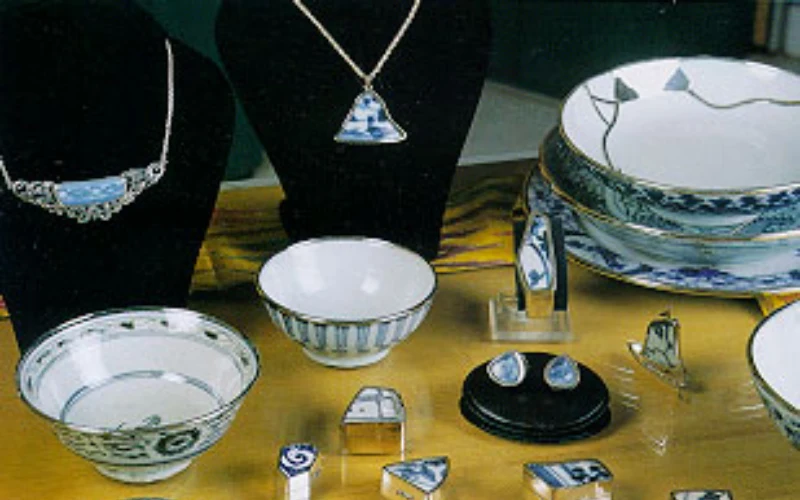
Over time, craftsmen began incorporating selected ceramic fragments into jewelry. A small section of a floral motif, dragon design, or decorative border could become the centerpiece of a pendant, ring, brooch, or locket.
The result is a unique blend of Chinese ceramic artistry and Southeast Asian silversmithing traditions.
Blue-and-White Porcelain
Among the most recognizable Chinese ceramics are the famous blue-and-white wares often associated with the Ming Dynasty (1368–1644) and later the Qing Dynasty (1644–1912).
The technique involved painting designs with cobalt-blue pigment beneath a transparent glaze before firing. The process produced the distinctive deep blue decorations that became highly sought after throughout the world.
The city of Jingdezhen in Jiangxi Province became the center of imperial porcelain production and remains famous for ceramics today.

As global trade expanded, millions of pieces of Chinese porcelain were exported overseas. Their influence can still be seen in ceramic traditions across Europe, the Middle East, and Southeast Asia.
Why Ming Porcelain Became So Famous
Chinese porcelain stood apart from most contemporary pottery. It was thinner, harder, more durable, and often translucent. Its brilliant white surface provided the perfect canvas for intricate painted designs.
During the Ming Dynasty, artisans refined their techniques and produced some of the finest blue-and-white ceramics ever made. Decorative themes often incorporated symbols representing prosperity, longevity, harmony, and good fortune.
Collectors today continue to value Ming and Qing porcelain for its craftsmanship, historical significance, and artistic beauty.
From Pottery to Jewelry
Transforming ceramic fragments into jewelry requires a keen eye and considerable skill. Artisans carefully select shards with attractive patterns and colors. Many fragments are rejected before a suitable piece is found.
The chosen shard is then cut, polished, and mounted by hand, often in sterling silver. No two pieces are exactly alike, making each item effectively a one-of-a-kind work of wearable art.
While many antique ceramic jewelry pieces feature fragments attributed to the Ming or Qing periods, buyers should be aware that accurate dating often requires expert appraisal. Reputable jewelers are generally careful to describe the provenance of their materials as accurately as possible.
The Tradition Continues
Although some of the individual shops mentioned in earlier versions of this article have changed ownership, relocated, or closed over the years, the tradition of incorporating antique ceramics into jewelry continues in Indonesia and elsewhere in Southeast Asia.
Today, visitors may still find ceramic-shard jewelry in selected antique galleries, artisan workshops, silver studios, museum shops, and specialty craft markets. Designs range from simple pendants to elaborate statement pieces combining silverwork with fragments of antique porcelain.
For many collectors, the appeal lies not only in the beauty of the jewelry but also in the connection to centuries of maritime trade, cultural exchange, and craftsmanship.
Each fragment tells a story—of merchants, sailors, artisans, and travelers who helped connect China, the Indonesian archipelago, and the wider world.
Originally published in Jakarta Kini, a publication of Indo Multi Media
By Danielle Surkatty