

Editor’s Note:
Indonesia is home to some of the world’s finest diving destinations, and Bali remains one of the easiest places for beginners to learn. While some of the hotels and dive operators mentioned in this personal account may have changed over the years, the experience of discovering Indonesia’s underwater world remains as inspiring today as when this article was first published.
Discovering Bali Beneath the Surface
Living in Indonesia and never learning to dive is a little like buying the biggest television you can find and never turning it on. You know there’s something extraordinary waiting to be experienced—you simply haven’t taken the plunge.
For years I managed to find every excuse imaginable. Perhaps it was watching Jaws as a child. Perhaps too many James Bond films convinced me that every dive involved sharks, villains and cut air hoses. Whatever the reason, I kept postponing it.
Eventually curiosity won.
One introductory dive in Bali completely changed the way I looked at Indonesia. Within minutes of descending below the surface, all the nervousness disappeared and was replaced by amazement. It became obvious why divers travel halfway around the world to experience Indonesia’s reefs.
Tulamben – One of Bali’s Classic Dive Sites
For a first dive, Tulamben is difficult to beat.
Located on Bali’s northeast coast, the area offers calm conditions, excellent visibility for much of the year, volcanic beaches and one of Indonesia’s most famous wreck dives—the USAT Liberty.
The Liberty began life as a cargo ship before serving during the Second World War. After being torpedoed off nearby Lombok, it was beached at Tulamben. In 1963, the eruption of Mount Agung caused the ship to slide into the sea, where it now rests between approximately 5 and 30 metres below the surface.
Over the decades, the wreck has become an artificial reef covered with hard and soft corals, attracting an astonishing variety of marine life.
Even beginner divers can explore parts of the wreck under the close supervision of a certified instructor.
A Relaxed Base in East Bali
Rather than making the long drive from southern Bali before dawn, staying overnight somewhere along Bali’s east coast makes for a much more enjoyable experience.
The original trip described here was based in Candidasa, whose relaxed atmosphere provided a welcome contrast to the busy streets of Kuta and Seminyak. Quiet gardens, tropical scenery and fresh seafood created the perfect setting before an early morning dive.
Today, visitors will find a wide range of accommodation throughout Candidasa, Amed and Tulamben itself, catering to every budget.
Learning the Basics
The introductory dive began with a thorough briefing covering:
- Equalising ear pressure
- Underwater hand signals
- Clearing water from a dive mask
- Recovering a regulator
- Basic buoyancy and breathing techniques
- Equipment familiarisation
Only after demonstrating these skills in shallow water did we head out for the dive itself.
Having an experienced instructor constantly nearby made all the difference. Every movement was carefully monitored, allowing complete beginners to relax and simply enjoy the experience.
Entering Another World
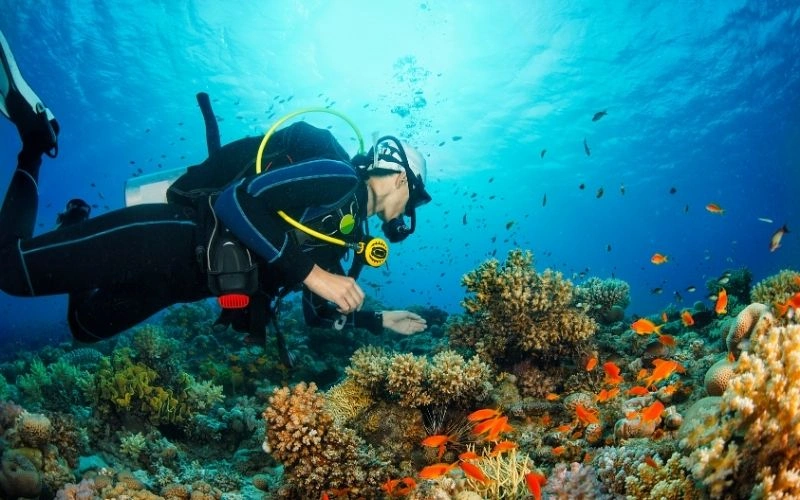
The moment we descended beneath the surface, anxiety gave way to wonder.

Coral-covered steel stretched out before us, transformed by decades beneath the sea into an underwater ecosystem bursting with life.
Schools of colourful Anthias drifted above the wreck while larger fish patrolled the shadows. Giant groupers, sweetlips, snappers, parrotfish, surgeonfish, unicornfish, garden eels and even a giant cuttlefish all appeared during what felt like only a few minutes underwater.
The experience was unlike anything I had imagined.
Although introductory dives are limited to relatively shallow depths, there was still more than enough to leave a lasting impression.
A Second Dive—and Complete Conversion
After lunch we explored another nearby site.
By then the awkwardness had disappeared. Breathing underwater had become natural and I found myself paying less attention to the equipment and more to the incredible scenery surrounding me.
When I surfaced nearly an hour later, I understood why so many people become lifelong divers.
It wasn’t excitement that stayed with me afterwards.
It was serenity.
There is something uniquely peaceful about moving slowly through an underwater world where every colour seems brighter and every movement more graceful than on land.
By the end of the day I wasn’t wondering whether I should learn to dive.
I was wondering how soon I could complete my full Open Water certification.
Diving Responsibly in Indonesia
Indonesia contains some of the richest marine biodiversity on Earth, making responsible diving especially important.
If you’re considering learning to dive:
- Choose a certified dive centre with experienced instructors.
- Never touch coral or marine life.
- Maintain proper buoyancy to avoid damaging reefs.
- Avoid operators that encourage feeding wildlife or unsafe practices.
- Support businesses that actively promote marine conservation and reef protection.
With thousands of islands and world-class dive sites stretching from Bali and Raja Ampat to Komodo and Bunaken, Indonesia offers a lifetime of underwater adventures.
By Jed Stone
Originally published in Hello Bali