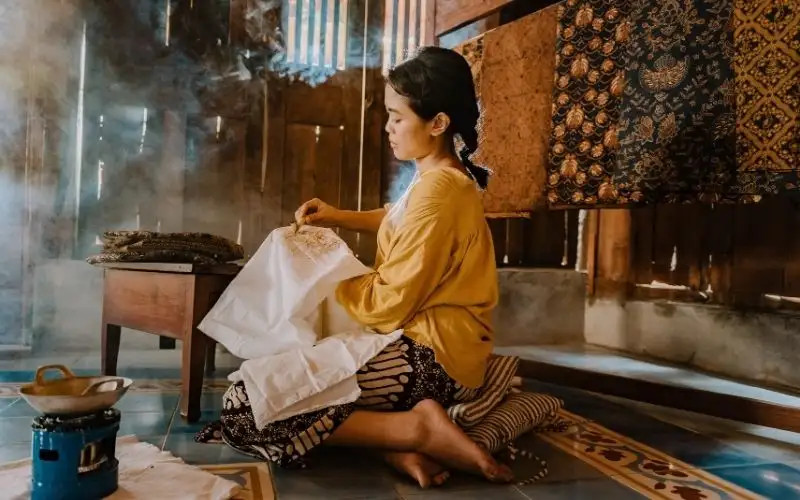


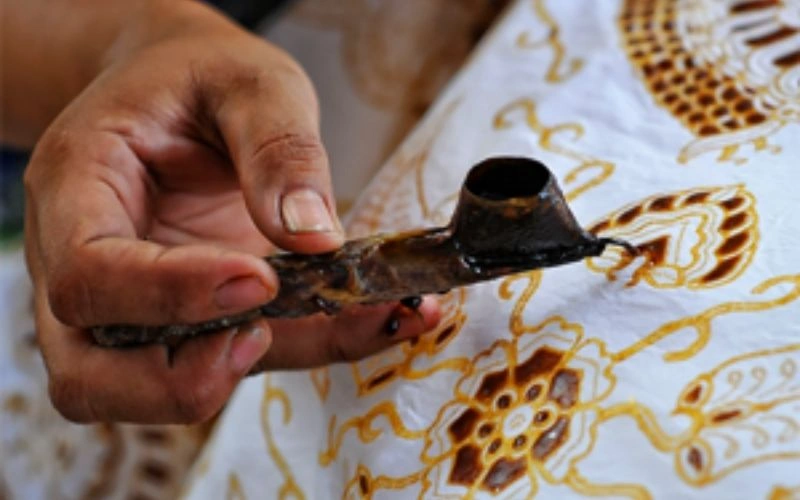
A canting (sometimes spelled tjanting using the old Dutch-era spelling) is the traditional hand tool used in the creation of batik tulis (hand-drawn batik). The canting is used to apply hot wax to fabric in fine lines, dots, and intricate patterns. Wherever the wax is applied, the fabric resists the dye during the coloring process, preserving the original color underneath.
For centuries, skilled batik artisans across Indonesia have used canting tools to create some of the world’s most detailed textile designs. The technique requires patience, precision, and years of practice to master.
The Parts of a Canting
A traditional canting consists of three main parts:
- The handle, usually made from bamboo or wood.
- The copper reservoir (bowl), which holds the melted wax.
- The spout or tip, through which the wax flows onto the fabric.
The artisan dips the canting into melted wax and carefully guides the wax onto the cloth by hand.
Different Canting Tips
Although most canting tools are similar in size, they vary in the size and shape of the tip.
Larger openings allow more wax to flow, creating thicker lines and larger dots. Smaller openings produce the delicate lines and tiny dots that are characteristic of fine batik work.
Experienced batik makers often use several different canting tools while working on a single piece of cloth, switching between tip sizes to achieve different design effects.
The Wax Reservoir
The small copper bowl or reservoir holds a quantity of hot wax while the artisan works. The bowl is designed to maintain a steady flow of wax through the tip, allowing the artist to draw smoothly and consistently across the fabric.

Creating Batik Designs Dot by Dot
One of the most remarkable aspects of traditional batik tulis is that many patterns are created entirely by hand. Individual wax dots are applied one at a time, often requiring thousands of separate movements to complete a single cloth.
The process can take days, weeks, or even months depending on the complexity of the design.
Drawing Fine Lines and Filling Patterns
The canting is not only used for dots. Skilled artisans use it to draw flowing curves, geometric patterns, floral motifs, and intricate details. Areas within a design may also be filled with closely spaced lines or dots to create texture and visual depth.
This painstaking process is one of the reasons that genuine hand-drawn batik is highly valued compared to printed textiles.
An Important Part of Indonesia’s Cultural Heritage
The canting remains one of the most recognizable tools in Indonesian craftsmanship. Although modern production methods exist, traditional batik artisans continue to use canting tools to preserve techniques that have been passed down through generations.
In 2009, Indonesian batik was recognized by UNESCO as an Intangible Cultural Heritage of Humanity, highlighting the cultural significance of both the art form and the traditional tools used to create it.